Doors to Nowhere!

Posted 01/11/2010 by IRONSandLADDERS
Categories: 6. Building Construction/Hazards

Tags: , ,

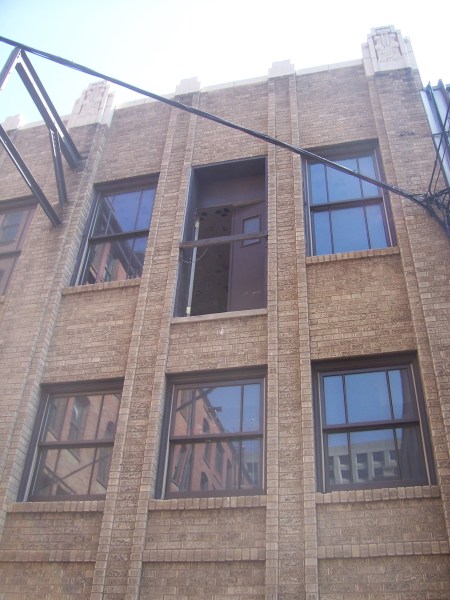
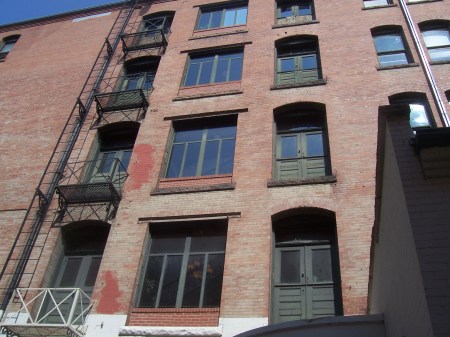
We sent this in to the website VentEnterSearch a couple years ago when it was initially posted. We felt is was time to show it again on our site for anyone that did not see it the first time. This is a great example of the types of hazards that can be found around your district. These first two were found in an alley of two different ordinary construction buildings. However these types of door hazards are not limited to the older downtown and westside neighborhoods of our city, they have been found in many other neighborhoods including newer commercials on the far east side and post-war buildings in the Southgate neighborhood.


You can see that the doors on the left open up to a fire escape, but on the right open up to a free fall that could be from the 5th story. The only thing preventing you from falling when the door is open is a small bar that is at chest height.


This next door is on the 3rd story and as you can see was open while taking the picture. They more than likely open this for ventilation in the summer. Again the only thing stopping you from falling out of this door is a 2×4 across the opening.

We will never find all of these hazards before a fire happens, but staying heads up and keeping our eyes open will keep us that much more ahead of the game.

Are there any doors to nowhere in your district?

Rain Roof Construction/Ventilation

Posted 01/04/2010 by IRONSandLADDERS
Categories: 6. Building Construction/Hazards

Tags: , , , , , ,

Rain Roof Construction

When a three story apartment building with a flat roof begins to leak the owner must fix the leak if he wants to keep his residents. When a building ages to the point that patchwork will no longer suffice, the owner must decide whether to move the third floor tenants to another building or to a lower apartment so that proper repairs can be made to the flat roof. Another decision that can be made is to build a peaked truss roof above the existing flat roof; no tenants will have to be displaced and therefore no money will be lost in rental fees.

These peaked rain roofs pose serious concerns to firefighters, not the least of which are the added void spaces and the increased difficulty in vertical ventilation.

The interior crews should expect to spend some time in a high heat and smoky atmosphere due to the extended time that it will take to ventilate this structure. The Truckies on the roof should be alert to what IS NOT coming out of the ventilation hole (smoke and fire)!

Because of the added void spaces, an extended overhaul should also be expected. Both void spaces (cockloft and attic) should be investigated and cleared of smoke and fire.

From the exterior of the building you can see that the outline of the flat roof is visible. This may be a way to recognize the possibility of a rain roof, however the only way to know absolutely, 100% that there is a rain roof is to pre-fire plan the buildings. Even if you have been told by someone you trust that a certain building has a rain roof, you should get up there and see the construction for yourself. Plan out the types of ventilation and the tactics before the fire, and when the fire happens, surprises are minimized and efficiency increased.
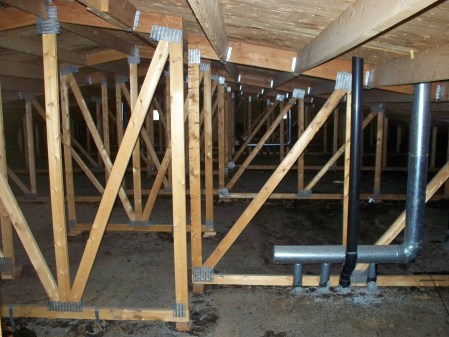
As you can see from the picture above, the load of the rain roof is carried by a truss system. The trusses run from soffit to soffit, in this system the trusses are set approximately four feet apart and are offset. If you look closely the truss system consists of half trusses and alternates from center to the right soffit, the next (four feet away) from center to the left soffit. The trusses are tied together with a lightweight 2x6x8, connected to the trusses with metal joist hangers. Note that these 2×6 members run lengthwise and are spaced about 20 inches on center. The trusses are held off the flat roof by placing them on wood scraps and fastened to the flat roof by metal hurricane straps and screws. The new roof is then sheathed with OSB or plywood, a layer of tar paper, and topped off with asphalt shingles.
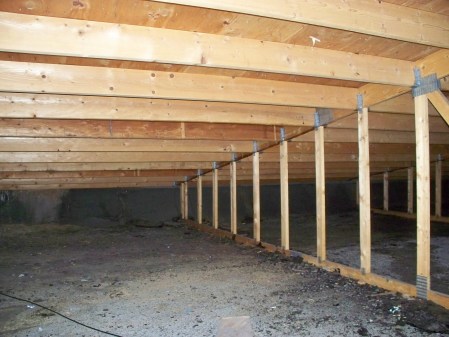
When we think about a normal (4×4) ventilation cut, it usually starts with the top cut (to find the trusses/rafters, then the far cut, the bottom cut, lastly the closest cut, the cut is then louvered vertically (peak to soffit). With this construction, if you start with the top cut (looking for the truss/rafter to gauge distance) you will not run into one unless you got lucky enough to plunge close to the truss (remember, they are 8 feet apart). Your next step being the far cut would normally be an easy, unobstructed cut, however with this type of construction you will note the saw bog as it hits the 2×6. If you did not get a chance to pre-fire plan this building, your confusion on the roof will begin to creep in at this time. After completing your cuts, you will notice that the louvers will now run lengthwise.

The cut is completed and your work on the roof is done! Well maybe!

Everything that is done on the fireground is done for a reason. Ventilation is a perfect example of this rule. Generally speaking, ventilation is done to remove heat and smoke to allow the Engine Company to find and extinguish the fire quicker, to give any possible victims a chance of survival, and to reduce smoke and fire damage.

Why do we choose to vertically ventilate as opposed to horizontal/PPV?  We have all been taught that any extensive top floor fire with a possibility of extension into the attic space or cockloft should be vertically ventilated to keep the fire from extending horizontally in the void spaces.

If we have a reason to vertically ventilate, then we should have some expectation of what should happen after we ventilate. In this case we would probably be expecting smoke or fire to immediately ventilate from the hole.

If what we expect does not happen, red flags and alarm bells should be going of in our heads! Something is very wrong and could mean the danger is increasing for everyone on the interior.

I personally have not been placed in this situation (ventilating a rain roof), so I will have to refer to those with the actual experience of operating on this type of roof at a working fire. However, I would immediately begin thinking that horizontal /PPV should be heavily considered.

By the way, before you get to far into the process, communicate to the interior crews and the IC that ventilation will be delayed at best, or that horizontal/PPV is a better tactic to go with.

A few years back there was a fire in an apartment building that had a rain roof. As I understand it Truck 8 was assigned to vertically ventilate. Lt Chapel was on scene and he advised that their main job was to force through a draft stop and extinguish fire in the attic void space. Maybe, he and others that were there will be nice enough to fill us in on the story and provide us with some first hand knowledge.

 Thanks to IronsandLadders.com for the great web site. Be safe!                            -Lt. J. Garcia


Lt. Garcia has a great deal of knowledge in building construction and his trade of fighting fires. He still considers himself a student of the job and pursues being a master of his craft regularly.  Lt. Garcia has been serving for the last 16 years and has spent most of his time in some of the busiest companies on the southside of the city.
Halligan bars….they are not the same.

Posted 12/28/2009 by IRONSandLADDERS
Categories: 1. Forcible Entry

Tags: , , , , , ,

The Halligan Bar

By Ryan Royal

In any profession, how well you know your tools directly reflects in the way you use them. A well made tool has obvious design and durability advantages in comparison to the cheaply made imitations. This is true with anything from channel locks to Halligan bars.  A well made tool is typically easy to identify if you pay attention to the details. Sometimes the fire service will sacrifice quality for price. This seems insignificant at the time, until we call upon the tool to perform.  Very rarely will a good mechanic settle for a cheap set of sockets, or a seasoned electrician use a set of discount lineman pliers. It is our responsibility as the grunts, the ones who will have the most hands on time with the tools to educate ourselves in the quality that they are made. If we are carrying sub standard forcible entry tools, the only way we can effect change is to be educated in their differences.

What we call the “Halligan Bar” has transformed through the years into many different variations. The original tool was made by Hugh Halligan in the 1940’s. This tool was an in-house invention and maybe the most widely used tool in the fire service. Hugh Halligan also invented the Halligan hook (also commonly known as the roof hook). The whole history of these tools can be an entire article in itself, but a major point to take from this is two of the most durable and useful tools still used today were developed by some creative firehouse ingenuity. Developed by problems that were identified on the fireground, taken back to the firehouse, and solved by a man who designed every specification for a reason. The problem with many of today’s different types of bars is they have varied from the specs of the original design in a negative way.

The tool that has stayed most true to the original specs and has actually improved on them is the Pro Bar. The Pro Bar has numerous advantages over its competition which are poor imitations of a Halligan. We will discuss some of the key points that make the Pro Bar superior as they relate with the following pictures.

The picture above shows you an overview of three types of “Halligans”. The Pro Bar (the upper most) is one piece drop forged steel, no parts to fail and at 30 inches is the perfect length. The other two are longer and are made by three pieces attached together. The details can be seen better in these close-ups. Many people buy a 36″ bar because they want extra leverage, however the 30 ” bar has plenty of leverage to defeat very fortified doors but will also fit inside of most standard door frames, something that the 36″ bar may not be able to do, but instead will hit the wall when you apply the leverage.

                                                                                                                                                                                           PICTURE 1 – (The Pro Bar fork is on the right)

(PICTURE 1)  This picture of the forks shows you the big differences between the fork end of the bar. You can see the one piece construction of the Pro Bar on the right and the two imitations on the left.  As you can see, the three piece bars have been attached by a pin, and/or a weld. You can also see the tapered V shape of the space in between the forks of the Pro Bar. This angle of the fork gives you a good design to slide over hinges and take a solid bite to keep the bar in place.

                                                                                                                                                                             PICTURE 2 – (Pro Bar fork is on the right)

(PICTURE 2)  The side view of the forks shows one of the most critical differences in the bars,  the difference that makes the Pro Bar the well designed tool. You can see the Pro Bar has a nice gradual curve of the forks to give you the leverage you need once the tool is set. The key advantage is how much thinner the forks are, this allows you to set the tool on those tight inward swinging doors/jambs. The other two bars have an obvious thickness to them that adds to the problem of what we are trying to defeat. Why would we want our tool to work against us? If the door we are trying to defeat is worth its weight, then we are going to want the thinnest possible fork to drive in between the door and the jamb. The well designed curve is what gives us the leverage not the thickness of the fork. If the fork is too thick we will not be able to set the tool deep enough to even apply the leverage.

                                                                                                                                                                                PICTURE 3( Pro Bar adze on the Left )

(PICTURE 3)  The last picture shows you the adze end of the tool. The adze end could be the most useful part of the tool, especially if you are using one-man techniques. The Pro Bar adze is longer than the imitation bars and has a gradual curve to it. The curve gives us a high point on the adze that creates more leverage then its flat competitors. The length of the adze also gives you an added reach when you begin to pass it by the jamb of outward swinging doors.

The other part of the adze end of the tool is the pike. The pike is difficult to see in this picture but the differences are obvious if you have a chance to look at them in your own firehouse. The pike of the Pro Bar has a gradual curve to it, and is also much thinner then the imitation bars. The thickness of the other pikes is a disadvantage because of the resistance they cause when you need to drive them into material. The Pro Bars thin pike makes easy work of driving it through a metal door. This becomes very important if you are attempting to defeat carriage bolt heads with your irons. The less resistance the better and that is what the Pro Bar provides.

Nothing in this is new, like many things in the fire service, it is tried and true knowledge that has been passed down to us. It is important that this information is passed along so you can develop your own opinions, with that said this is an easy and obvious opinion to form for anyone that has been using Pro Bar Halligans.

Check out these old pictures from the original Halligan ads.

EDIT:   Right after posting this I was talking to Andrew Brassard from Brotherhood instructors. He also just wrote an informative article on this topic. We must have been thinking the same thing for a holiday article, both of these echo each other. Please take a look at his to reinforce what was said in this article. They also have a great picture of a three piece bar that has failed.Here is the link……Thanks Andrew for the heads up.

Next Up:  Modifications and Alternate uses of the Halligan

Ladder work…the unconventional way

Posted 12/21/2009 by IRONSandLADDERS
Categories: 5. Ladder Work

Tags: , , ,

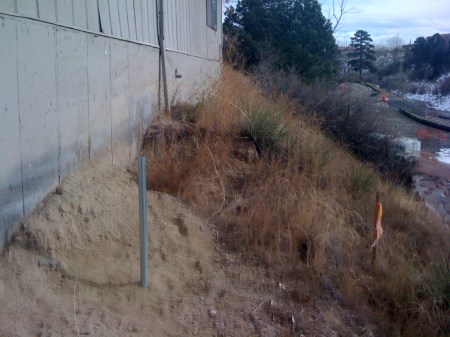
This next post is a great example of unique situations you can find throughout your district. This was found by a group of guys on a truck company that is aggressive about knowing their district. This specific building was found in an area of our city that backs up to some hillsides and drainages. It is a unique area of terrain surrounded by urban infrastructure on all 4 sides.  They found something that is all to common (poor ladder access) and at least gave themselves a game plan.  The area in question has a high chance of needing ladder rescues, especially at night due to the location of all the bedrooms, and the common wood stairwell on the front side.  There is one way out, and if it’s on fire they are all heading to the back windows and balconies. Below are the pictures, and then a quick narrative from the driver of the truck company that found this.


These apartments are located in T10’s still district off of York and Academy.  I first discovered them several years ago when stationed at 14’s.  This complex consists of four separate multiplex apartments.  Truck operations will be challenging for several reasons.  First, apparatus access is very limited.  There are two very narrow drives that access the small parking lot in the middle of the four buildings.  Truck companies will not be able to access the two southern most buildings via the west driveway because very low hanging power lines will prohibit the truck from gaining access.  Once accessed the parking lot is very small and depending on the number of vehicles may require a short set for aerial use.  The biggest problem trucks will face is ladder access on the rear of the two southern buildings.  The back of these buildings face a park and drainage.  The drop off and terrain are so severe that traditional ladder access is extremely difficult.  Several possible alternative rescue scenarios exist, including using a roof ladder with hooks extended like a pompier ladder and hanging it from the balcony or window. Using the roof hooks to secure the ladder may be unconventional, but actually gives you a fighting chance at keeping the ladder in place while bringing victims down. You can still attempt to give yourself a climbing angle but with such uneven terrain the hooks will prevent that ladder from sliding down the slope of the hill.

IRONSandLADDERS.com Site Update

Posted 12/18/2009 by IRONSandLADDERS
Categories: 7. Everything Else

Tags: ,

Some quick updates we would like to make every one aware of. We finalized ownership of the domain name ironsandladders.com.  You may have noticed before hand we were at ironsandladders.wordpress.com. This is not a big deal as both links still go to our site. You don’t have to change anything if you have it saved, however from now on you can link or save this site as ironsandladders.com

Next, If you have not noticed the Tactical Safety articles( located lower on the page) are updated weekly. If your interested in keeping up with them we post the updated link once a week with the date, under the original Tactical Safety post.

Fire Nuggets has opened their sign up for the 2010 Professional Development Series in Denver   These guys consistently provide five high quality classes with speakers from all over the country. You can receive a hundred dollars off if you sign up before February. It looks like a good line up this year and I look forward to attending all of them. If you are interested here is the link 2010 Fire Nuggets Classes

Lastly anyone still interested in the upcoming Engine Co. classes on Jan 6th must sign up soon. The guys running that (twoknuckleheads@gmail.com) have let us know that 90 out of 100 positions have been filled.

Thank you for the interest in the site, we have a ton of content still to come.

Residential Rolldown Security Shutters

Posted 12/14/2009 by IRONSandLADDERS
Categories: 1. Forcible Entry

Tags: , , ,

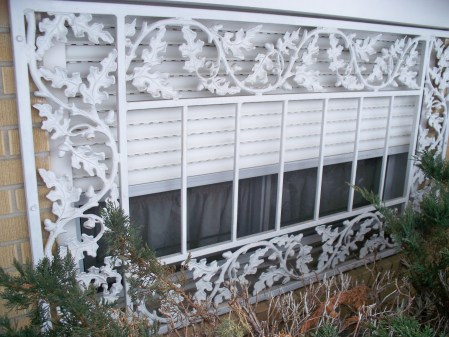
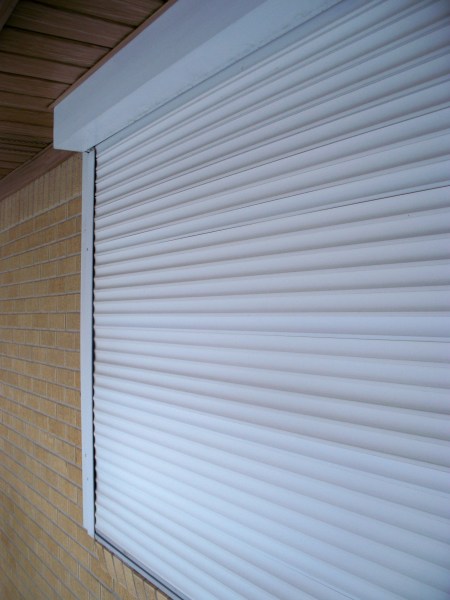
These are fairly unique on residential homes in this part of the country, but we have noticed a few popping up in our still district. I would imagine these are much more popular in the coastal parts of the country where they protect homes from hurricane damage.

 After running an alarm in this house we were able to take a closer look at how they are setup and installed. The reason we are seeing them out here is for security reasons. The elderly lady that owns this house informed us that she has been robbed a total of 12 times over the years. She lives in this home on a fairly busy street in an area where break-ins are not uncommon. I got the feeling that she has lived here for a very long time, probably before the neighborhood had started to decline. To secure herself this is what she came up with.

The pictures below let you see the roll down aluminum security shutters and the window security bars. What you cannot see by these pictures is that every window on her house, including the second floor have this security added to them. Not to mention the razor wire that has been installed on her fence that surrounds the backside of the house. Take a closer look:

The frames are installed as the top plate for the windows on the interior of the bars. However in the next pictures you can see that the metal framing for the shutters is more to the exterior of the building. Underneath you will find more window bars that are concealed behind the shutters.

These just add a curve ball into the standard ways we would perform horizontal ventilation, not to mention the work load that is added for the outside truck crew.  It also creates a great deal of egress issues. A few questions to think about.

How will this effect locating the fire from the outside? How long would it take a crew to remove, especially on the second floor?  Call an extra truck company?  Effects on smoke and fire behavior?

Thoughts on a Balloon Frame

Posted 12/08/2009 by IRONSandLADDERS
Categories: 4. Ventilation

Tags: , , , ,

Our next IRONSandLADDERS author is a Lt. on a truck company in downtown. He has served our city for 28 years and set a great example of being a tradesman to all. Here is some of his thoughts relating to the following video and other thinking points that arise with balloon frame fires.

 Note on the Video: when you click play the video will not show on our site. Click the “Watch on You Tube” link that comes up after clicking the video. If you are not getting the right video click this link http://www.youtube.com/watch?v=aTQWNCeCBvQ

 TWO STORY BALLOON FRAME FIRE 

  It’s often said that when fighting a fire in a balloon frame structure, the fire department can do everything wrong and still make a successful hit or we can do everything right and still burn it down. There are many reasons for this: undetected fire in hidden voids and confined spaces (to include the attic), misuse of PPV, and not recognizing the importance of vertical ventilation in these structures to name a few.  The questions that came to mind when I first watched this video:  

– What were the fire and smoke conditions on initial arrival?

– Because of the amount of fire that is showing from behind the chimney when it fell; did the fire start in the chimney chase on the first floor and travel to the attic? If it traveled to the attic could it also have dropped down to the basement?

– Was it the action of a firefighter pulling ceiling on the second floor that caused the backdraft or smoke explosion?

Below is my short list of “Watch-Out Situations” when dealing with balloon frame structures. Some may pertain directly to this video while others may not.  

PPV – Due to the air movement in the hidden voids and confined spaces, to include the attic and basement, consider not using PPV until it’s confirmed that the fire is confined to a room and/ or its contents. Another situation would be the fire that’s confined to the hidden voids and confined spaces; these must be identified and isolated if you are going to stay ahead of the game. 

RECON – The initial arriving truck company needs to RECON the fire floor, the basement and the attic. These structures can be large and are often converted into apartment buildings. The crew that’s deploying the initial attackline may need aide in finding the stairwell that leads to the fire room.

VERTICLE VENTILATION – An attic that has trapped hot smoke and fire gases must be relieved by venting high and on the leeward side when possible. To do otherwise may result in a similar event like the one that played out on this video. I place a high consideration on having the Ladders crew place the aerial to the roof on arrival while the Irons side performs RECON. I would not have considered using PPV.

CHIMNEYS – ALWAYS a concern in a structure where two or more stories of chimney brick were laid 100 years ago and have been subjected to fire conditions. Never mind that the darn thing could fall with a gust of wind due to termites, old and weak mortar and an under-engineered foundation. Keep your eyes up when around these things; safety officers should make this a priority concern.

 The first sentence left out another viable scenario, which is to do everything right and put the fire out. This will make those post fire evening cigars or early morning pancakes all the more tasty……               Lt. Les Chapel 

Ray McCormack – Full Day Class in January 2010

Posted 12/04/2009 by IRONSandLADDERS
Categories: 2. Hose Work

Tags: , , , , , ,

A couple of guys who have been working to put this class together sent us over some information and the attached flier. Ray McCormack will be teaching a class on two different topics as follows:

Engine Company Errors- The Dirty Dozen

Line Boss- About the Engine Officer and Hose work

These classes will be limited to the first 100 people who sign up and only cost 50 dollars for the full day class. A tip of the hat to the two guys (twoknuckleheads) that spent the time and energy in making this class possible. Please review the attached flier and hang it in your firehouse if you would like to help spread the word.

A detailed description on the classes and registration information can be found in the attachment. If you are interested please do not contact IRONSandLADDERS rather use the email address found on the flier. We do not want to be responsible for you losing your spot before the class fills up.  

CLASS INFORMATION FLIER


Update: 50 out of 100 spots have been filled

Update: 75 out of 100 spots have been filled

Update: 90 out of 100 spots have been filled


Door Size Up #2

Posted 11/29/2009 by IRONSandLADDERS
Categories: 1. Forcible Entry

Tags: , , ,

The second door we have is an interesting one. It is very obvious upon size up that we have multiple security features to this door (which is not always this obvious). Take a look and a guess…..then scroll down and see if you were in the ballpark.

Remember the key points to look at sizing up before you plan your attack.

  •  Building Occupancy (which we will give you) 
  • Construction type
  • Which way it swings
  • Type of door/material
  • Type of jamb/frame material
  • Locking devices and bolt patterns (primary, secondary and so on)

This door was found on the backside of a L-shaped 2 story wood frame commercial. The building has multiple storefronts, and many business on the second floor also. This specific unit was a large rental center and the tenant had multiple previous break ins.

And here is the first step of the interior.

Just as you begin to think you’re getting a handle on the door you find this next.

What was the outside telling us??

Just walking up to this door we can see pretty obvious signs of heavy fortification. The numbers above go along with the following descriptions:

  1. We have a typical  door handle and rim cylinder combination. This type of hardware showing, along with knowing the occupancy, will tell you this has panic hardware on the backside. This lock setup is not very substantial alone, and may be all that is holding this door shut if it is daytime hours.
  2. Next we have two sets of carriage bolts mounted right above the panic hardware setup. These bolts should tip us off to some kind of drop bar mounts installed on the inside.
  3. Third we have two sets of 4 pattern carriage bolts. One set up high and one down low. These more than likely tell us that we have either slide bolts into the jamb, or padlock hasps installed. The location of the bolts near the edge of the door and the pattern of the four bolts are what is unique to these types of setups.
  4. The fourth characteristic basically tells us they have fabricated something inside that requires heavy-duty anchors through the entire exterior wall. Untill you see the inside, you could be thinking a number of things.

How do we defeat this?

Many people give this door much more credit than it deserves. The doors looks impressive from the outside and has some great points for talking about size up, however this door can be handled with a set of irons and some assistance from the saw. It is going to take longer than some but is still very reasonable to make as an option on the fire ground. Don’t let the internet fool you, C4, trucks with chains, find another door or this is impossible are not viable answers.

  1. Start conventional, Gap Set Force. During daytime hours this door was regularly locked with just the panic door. If that’s the case we are in with ease. If it is all buttoned up the halligan will still expose the weak points and we can conventionally pry open every lock you see on the outside door.
  2. Pry near the primary lock and the drop bar bolts, this is a great starting point and will be defeated with a set of irons and a hook if needed. This will also tell us what else is locked on the door.
  3. Next pry near either the upper or lower set of bolts that is the slide bolt. These offer some decent resistance if they are mounted correctly but can be overcome with irons. If one is ever holding on a little better than normal, the 6′ hook as a cheater will destroy these.
  4. After that this door is open to the roll down gate. Remember if you have a running saw you can always cut the shafts of these carriage bolts to assist you with loosening everything up. I am not anti saw and would absolutely do this also, just know irons can get you in these basic locks. When using the saw make smart cuts, start with the bolts on the lock side, ignore everything on the hinge side unless it is needed.
  5. While we are working on the outside door, hopefully someone has sent for the saw by the time we get to the roll down door behind it. This is going to be forced by the saw much quicker at this point.

Check out our commercial forcible entry videos on you tube for detailed instructions on forcing this exact type of door.

Engine ? arrives with fire showing 1st floor, confirmed child trapped on the 2nd.

Posted 11/24/2009 by IRONSandLADDERS
Categories: 3.Search/Rescue/VES

Tags: , , ,

First due company arrives and has a father and grandmother in the front lawn confirming a 2 year old trapped on the second floor. The rest you can see for yourself. Note in the first few seconds the firefighter coming out the front door with the kid. Also later in the video after the man confronts the camera watch him return to the scene and start pushing a firefighter around. The father has now been charged with arson for this fire.                         Heres is a write-up from the Englin Fire Chief

Elgin Fire Department Battalion Chief Terry Bruce said once emergency personnel arrived, they soon were informed by occupants that a baby boy remained inside, sitting in a high chair on the second floor of the tri-level home.

  He said Elgin firefighter Kevin Hartmann went inside and was able to find and remove the child just as smoke was entering the room.  “The smoke was just starting to build up right near the baby,” Bruce said. “Another couple of minutes and the baby probably would have been overcome by the smoke.”  Three dogs also were rescued from the home, Bruce said, but a fourth was not recovered.  An already highly emotional scene became even more dramatic, Bruce said, when the baby’s father suddenly became irate and began to assault several firefighters, requiring Elgin police to restrain him.

  The baby’s grandmother tried to put out the fire when it started, but she had to leave the home, Bruce added.  The blaze, which started in the first-floor bedroom that belonged to the boy’s father, was brought under control in about 30 minutes, Bruce said. 

We don’t want to arm-chair quarterback these guys because the bottom line is they made a save in a situation that they were behind in from the time this man started the fire.  That being said we would like to hear your thoughts and points that we can learn from. 

Firespread?….Rescue?…Next in assignments?  What do you think. Answer in the comment box if you have any.