Portable Ladder or Portable Stairs?

Posted 03/06/2010 by IRONSandLADDERS
Categories: 5. Ladder Work

Tags: , , , ,


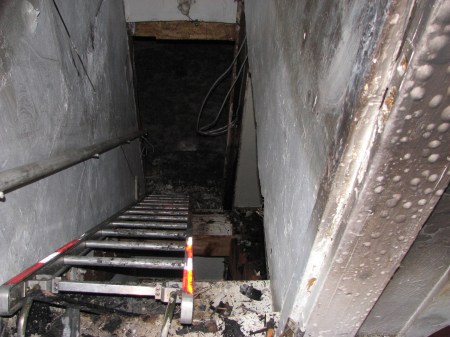
Here is an idea to keep in the back of your mind if you encounter the same problem. These companies had a fire on the top floor of a 1  1/2 story house a few months ago.  The house is located in a neighborhood on the eastern edge of downtown that has its fair share of urban decay. When advancing the line they found the stairway leading up had some damage. Enough damage to require some assistance making the top floor. The Engine had pulled back and advanced up an exterior ladder that was in place to the top floor and made a knock down. While the Engine made their way up, the Truck company was able to place a 16′ ladder in place over the area of the stairs that was damaged. This provided a sturdy and safe way to secure another route of egress for the Engine upstairs, and access for the Truck that ended up helping them confine the fire to its room of origin. Once the fire was knocked down it turned into the main pathway for the remainder of the incident.  This is where remembering little tricks that have been passed down to us pays off. Well done on thinking creatively and looking out for each other with a little ingenuity. Thanks for sending in the photos for everyone to share.

No Room For Complacency

Posted 02/28/2010 by IRONSandLADDERS
Categories: 5. Ladder Work

Tags: , ,


This was on the 5th floor. How fast can you setup your aerial?

Head First Ladder Bailout

Posted 02/21/2010 by IRONSandLADDERS
Categories: 5. Ladder Work

Tags: , , , , , ,

This is a very recent video that was taken at a fire only a few days ago, you may have seen it around the web as it is on many different sites. Sorry it took us a while to get this one up.  To give you a little background of the fire it comes out of Randolph NJ. Firefighters were searching the 2nd floor for reports (by her sons who escaped) of an elderly lady trapped inside. Conditions changed rapidly and this firefighter made it to the second floor window. You can see him hanging by his feet in an attempt to get out of the conditions and preparing to jump. The video you see is a first hand view from the RIT team that was located near the backside. From what we have found the firefighter was injured but not seriously. Despite their efforts the occupant in the house died in this fire.

This turned into a great video for us to learn from. As always we are not interested in bashing this department, we respect them for putting this video out for all of us to learn from and we should do exactly that. The video gives us a grasp of how fast these situations can unfold, and also how our responses in the heat of the moment will not always go as planned. It appears the firefighter is very exhausted by the time the ladder gets to him and it seems difficult  for him to even grab the rungs.

I received some great insight and advice pertaining to this video in emails. They are some thoughts from many different senior and experienced firefighters from across the country and here locally. Here is a brief take on many of these guys thoughts put into one paragraph.

Ladder deployment and placement. With firefighters operating in less than desirable conditions on the second floor we must have as many ladders as possible thrown to the windows. When you are on fire you are coming out of the window, ladder or not. The RIT team was able to acquire a ladder and quickly deploy it to the firefighter hanging out the window. However in the heat of the moment you can see the ladder is at a steep angle making it more difficult. Ladders placed before conditions change gives us the extra second to set up a much easier angle to slide down for egress. When time is crucial and you have an extension ladder that only needs raised a few rungs don’t forget how you raise your extension ladder at home. Once you set it, push up on the rungs by hand until they extend right under the firefighter. Placing egress ladders in grass/dirt compared to concrete will change the angle we are able to operate on. We are afforded a much more shallow angle when we have soft footing to sink the butt into. We must be absolutely proficient in these techniques before the real time comes. Regardless if you train on head first bails all the way down the ladder, or the hook 2 grab 4 spin technique you must pick the one you are comfortable with and be solid in its use. We do not want to be trying to remember these escapes when it goes south and we are already exhausted.  We can use our feet on the window sill to gain control of our body weight until are hands are gripped tightly on the ladder. Regardless one of the number one pieces of advice is to get someone up the ladder to assist the firefighter. We can see how exhausted and possibly disoriented the firefighter in this particular video is. Getting help up to him and guiding him on the ladder, even if he still comes head first down will ensure he stays securely on the ladder. 

Thanks to A. Brassard for the link and email discussion and Thanks to Bryan and the guys at 10s for the heads up on the video.

Clearing a Flooded Saw

Posted 02/16/2010 by IRONSandLADDERS
Categories: 7. Everything Else

Tags: , , ,

This is one of those topics that usually generates many different opinions due to personal experiences. Anyone that has been around small engines, or enjoys working on 2-stroke motors will usually be somewhere along the lines of what we are going to suggest. With that said if you have different ideas or another way that is tried and true for you, then you are welcome to throw it in here for everyone to discuss.

Troubleshooting a flooded saw in the field could make or break whatever task you have been assigned to. We all know that if the saws are not checked, ran and maintained it becomes very easy for them to flood from the constant bumping around that happens while driving around town.  If they have started to flood you will notice the blue smoke that burns off in the first 5 seconds or so of getting them fired up. There are many different scenarios of when and how the saw may flood. One very common way is operator error. This can happen when someone initially attempts to start the saw but goes through the wrong procedures.

Every saw starts with just a little different touch. One of the best ways to know each of your saws is when you start them in the mornings. You begin to pick up on the little differences of each one. Some may need choked longer, some may need a quick half choke, others may be a one pull start if your quick on the choke. Either way we should know what is normal and what is not.

For the sake of this scenario we will say that the saw was flooded by starting it wrong. So the saw is cold and we have cycled it enough times with no spark that it is successfully flooded. What’s next?  This is where our troubleshooting method comes in, we must have an aggressive way to clear the saw in a timely manner or else it is out of service. We know time will correct floods eventually but that is what we don’t have. We have all heard pull the plug out and let it air, which is fine if we are at the station and not in need of a working saw. 

Here is a quick tried and true way that works with a great success rate when you need to clear a flooded saw immediately. A solid understanding on how the choke and fuel system works will only increase your success rate with this tactic.

1st- we recognized the problem (flooding) and we switch to our troubleshooting start. 

2nd-We place the ignition, if present in the on position enabling a spark. (This will be one of the points that I am sure will be debated…but hang with us)

3rd- Next we want the choke open/off, this allows the maximum amount of air to flow through the carburetor, which is key to clearing out the saw.

4th- You will squeeze and hold the throttle which causes our saw to be “wide open”. This is the second step in having the maximum amount of air with the least amount of fuel coming through the saw. Don’t be concerned that your dumping fuel in while the throttle is open, because your not. The saw will not effectively start pulling the full fuel mixture until the engine is running full speed. This is why we get maximum air without max fuel.

5th- With the choke and throttle wide open you want to grab on to the pull cord and cycle the saw quickly about 8 times. Typically this will effectively clear the saw enough that we can focus on starting it. This brings us to the reason of why we like to leave the ignition on. Many times you may get a “hiccup” out of the saw and be able to get it running quickly after you cycle it. If not we move to our next step.

Now that the saw is cleared you will move into starting operations as close to normal as possible. These steps can vary slightly based on what you hear and feel with the saw. Put the choke back to the on/closed position and give it a few pulls, maybe move into a half choke based on what you hear, and then most of the time you will have your saw started. Make sure you are practiced and comfortable with these steps so it becomes routine when you have to do it on a real scene. That rare instance will always exist where the saw is just not going to start that day for many unknown reasons. However this  technique, if done properly will get your flooded saw running again almost every time.

Local Training Information

Posted 02/10/2010 by IRONSandLADDERS
Categories: 7. Everything Else

Tags: , , , ,

Two different groups are putting on some training around the area that we wanted to put out there for anyone interested. We have attached flyers for both of these classes where you can find further details and contact information. They should bring in some good training and I want to thank the people that have put in the time and energy towards bringing these classes to the area.

February 12th 2010, 9am till 4pm (This Friday)

 There will be a class presented in Denver titled “Developing Recipes for Operational Success”. This will be a roundtable type discussion on tactics regarding fires in many different types of building.  The instructors are from multiple different departments from across the country. 

Click Here for Details and Contact Information

May 3rd 2010, 9am

There will be a class presented in Colorado Springs with two different topics.  BFD Captain Pat Nichols will present a morning class reviewing lessons learned from the LODD “Tia-ho Reasturant Fire”.  The afternoon portion of the class will cover topics and lessons on “Ladder Work”.

Click Here  for Details and Contact Information

Please use the contact information of each of the companies that organize these classes ( Found on the links)..  Please DO NOT contact, or try to register  through IronsandLadders.com. We do not have any further information and are not running the registration for the classes. We had multiple people send emails trying to register for the last set of classes we linked to and we are not responsible if you miss out on a seat. Thanks

Video Training: Structure Fire With Rescue

Posted 02/07/2010 by IRONSandLADDERS
Categories: 3.Search/Rescue/VES

Tags: , , , , , , ,

This video starts out a little slow because it shows the response  to the fire, however if you skip to the on-scene footage it is worth the wait.  The truck arrives in the video at about the 1:30 mark.  This video has been around for a couple years and provides some good training footage, it originates in Columbus Ohio. The first photo we have posted just gives you a clear day time view of the street and occupancy.

A couple things to notice in the video. It appears that when the rig arrives there is already at least 1 engine and 1 truck on scene. The engine is getting a line flaked out and the truck appears to be getting ready to make a search of the floor above. There does seem to be a slight delay in getting water to the line, with that said we are not sure if it was a problem at the pump, or just a normal delay from performing a reverse lay to the hydrant. The video captures some good fire development and the speed at which it can be knocked down. We will let the video speak for itself.

Something that stands out to us is how much everyone is counting on each other. The truck crew is heavily relying on the engine to make a knock down and the engine crew is relying on the truck crew to make the rescue so they can focus on extinguishment. Obviously the citizen (unconsciously) is relying on both crews if they have any chance of making it out of this building.  If either crew would have not done their part on this fire,  the outcome could have been much different. From our research we found that  the first arriving units had no reports of victims trapped.  This victim was pulled out unconscious with some 2nd degree burns but had reportedly survived the fire.

We welcome any thoughts or discussion on this video, please keep it productive and related to learning as much as we can.  I think we can agree that videos only give us a small look at these scenes (that we were not on) and it becomes very easy to pick apart the things that went wrong. However they present a greater opportunity to discuss lessons learned, what went right and what we may change next time.

We think this specific video brings up some excellent points such as: Search priorities? Ladder work/Egress ladders? Where do you take the 2nd line? Ventilation on this structure? Bringing your own water or not?….and many more.

Not All Egress is Created Equal

Posted 01/31/2010 by IRONSandLADDERS
Categories: 6. Building Construction/Hazards

Tags: , , , ,

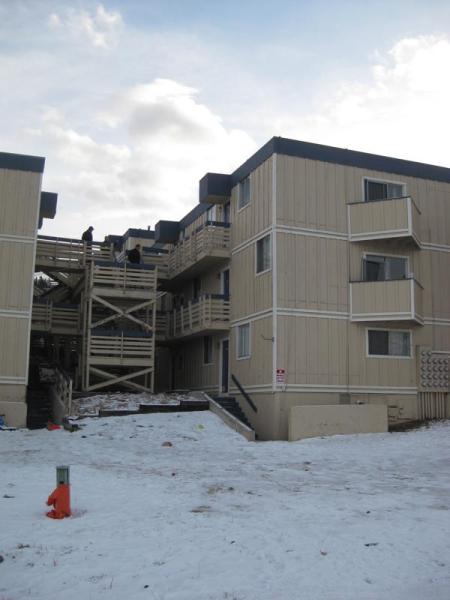
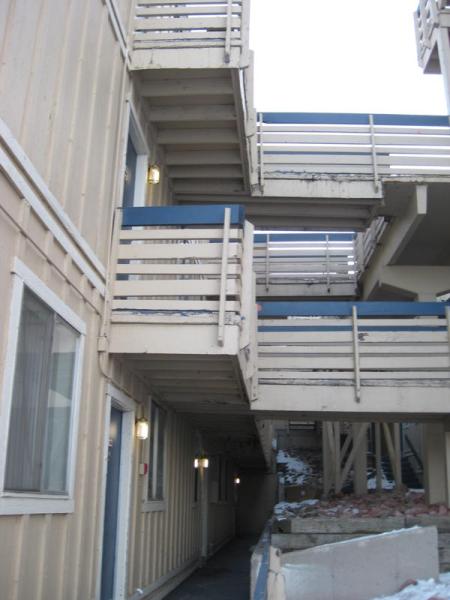
This is a great example of knowing our still districts and the areas that we know will present unique problems when on fire.  As you can see this building presents a nightmare of a stairwell, especially if the stairs are a target of arson or lower apartments begin venting fire and smoke into this common area. We can almost count on occupants hanging from windows if the fire is anywhere near this area of the building.  Thanks goes out to 4’s for the write-up and pictures.

This is in 4’s still district just above Motor City.  There are several apartment buildings in this complex (at least 10) and they are paired in sets of two.  This is the center “web” of stairs that connects one building to the other and is the only way out for most of the residents.  So which way is up?  Good question.  The fact is every stair maze is different.  In most cases in order to get to the top floor apartments you first must go down at least one flight of stairs, over and back up at least one flight of stairs to get to a pathway that subsequently leads you to the right set of stairs to make it to the top(Sound like a maze?…It is).  How do you get down?  Well the answer is about the same as above.  There is no direct pathway to the bottom level and what you thought would have been the bottom may surprise most people to find at least one unit tucked to rear of the structure. 

 How is this complicated stair structure supported?  The only main walkway is a single twin tee concrete beam supported by concrete posts and some posts are supported by steel box supports.  From this center piece, all of the paths are constructed almost as if they are built to access only one or two units before a different path is constructed. 


As you can see, ladder access is difficult at best.  To get from the parking lot you almost always have to go down hill to get to the building.  You would think there is road access from the “C” side of the structure because of the two plugs back there, however access is minimal because of the off road conditions you would encounter to reach the hydrants, and thats if they are even working. Because of the grade/terrain ladder access from the rear is down to 35′ or 45′ ground ladders and even those can only be used in a few places due to the terrain.  The building does have some pull stations but it is not monitored and still requires someone to dial 911 before the FD will receive any info that there is a fire at this building.  Throughout the maze of stairs you will find BBQ propane grills, spare LPG bottles, trash and gas meters all tucked away into any area that is protected from the weather. 

What is your thoughts?…..1st floor fire vs 3rd floor fire, ladder rescues, first line, stretching the line, search.

Class 2 Standpipes…..What For?

Posted 01/24/2010 by IRONSandLADDERS
Categories: 2. Hose Work

Tags: , , , , ,

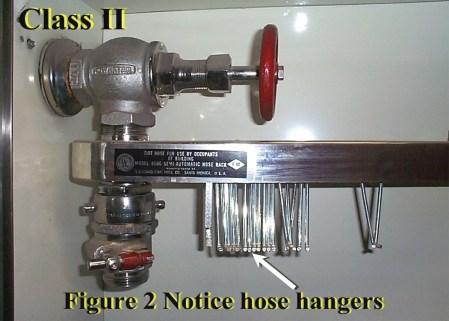
CLASS II (NON-FIRE ATTACK) STANDPIPE OUTLETS IN BIG BOX STORES

L. Chapel


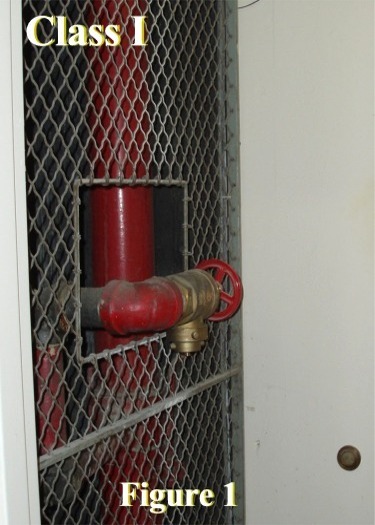
There are three classes of NFPA approved standpipe outlets found across the nation:

Class I – 2.5” hose connection intended for fire department use only.

Class II – 1.5” hose connection (with hose) intended for occupant use only.

Class III – 1.5” hose connection (with hose) intended for occupant use only, and a 2.5” connection intended for fire department use only.

Some nineteen years ago, all the old 1.5” single jacket hose was removed from all Class II hose cabinets in our city. This was to prevent occupants from attempting to fight a fire using these old systems that were equipped with untested hose and very low flow nozzles. This of course rendered these outlets useless, and rightly so.

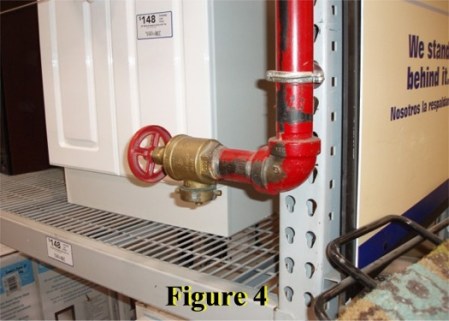
 While walking through a modern big box store have you ever notice those 1.5” standpipe outlets (SPO) that are attached to product display racks? Have you ever wondered why they are there and who would use them? Figure 4 was taken at a Lowe’s store and is typical of this type of installation.

 If they where meant for the fire department to use during a fire attack, they certainly would have been installed as a 2.5” Class I approved SPO. And even if they were, would you want to hook up to an interior SPO that is on the fire floor whereas a retreat would lead the crew back to the SPO, and not to the safety zone of the building’s entrance/exit? They’re not technically for “occupant use only” (Class II) because these new systems were never outfitted with hose. The best explanation I’ve heard is they’re for the fire service to use once the fire is out and we can then attach a 1.75” hose to perform mop-up. But this is a head scratcher since all we have to do is remove the smooth bore tip from our 2.5” attackline bale and attach our 1.75” mop-up line. So I put these SPO into the same category as all the other Class II standpipe outlets; pretty much as worthless as tits on a boar hog. 

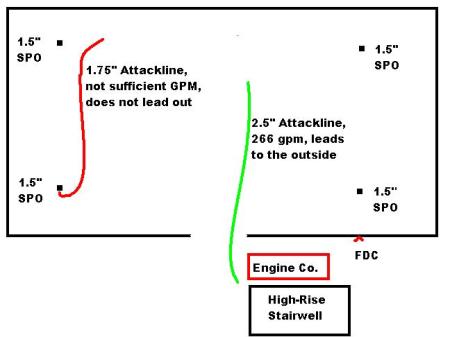
To further clarify my statement about not wanting to hook up to an interior SPO in a big box store (wide-rise) one must consider that in a high-rise, we hook up our attacklines in the stairwell at least one floor below and stretch to the fire floor. This gives us the safety zone of the stairwell to operate from, or retreat to if needed. We really have only one safe option when considering where you stretch your attacklines from. They must be stretched from the engine. The attackline leading from the engine and through the entrance/exit will lead back to the safety zone; and that is to the outside where the engine sits.

Whether it’s a ground floor fire in a wide-rise, a ground floor in a high-rise, or the tenth floor of a high-rise, the concept of the attackline leading to and from a safety zone is illustrated below. Also; just as a high-rise building is considered a commercial structure, so is a wide-rise or big box store. Choose the size of your attacklines accordingly.

Baltimore Footage

Posted 01/18/2010 by IRONSandLADDERS
Categories: 7. Everything Else

Tags: , , , , ,

This footage is flying around the internet and has been suggested to us from multiple sources. We dont know who gets credit for it because it has been seen on VentEnterSearch.com, Statter911.com, and many others. The important thing is for it to reach anyone who wants to see it. Here it is off of YouTube, the writeup below is information that was obtained by Statter911.com

The original video has been removed……Here is the link for the extended version

FROM STATTER911

“STATter911.com has exchanged emails with Baltimore Fire Department Chief Jim Clack this evening. The chief has given us a preliminary run down of what happened leading up to what he says appears to have been a flashover at the fire on Northeast Avenue this morning. (I know, as is normal with these videos, there is a raging debate as to whether this was actually a flashover,  backdraft, or something else.  As usual, I will let you, and those investigating the incident be the judge.) 

According to Chief Clack the fire started in the basement of an occupied row house and appears to have been burning for “a while” before the fire department arrived.  The first engine took a line through the front door to the rear kitchen area. The chief says that crew had some trouble finding the basement stairs. They were in the kitchen when it flashed.”

Updates are still coming in from different sources, we have heard that 7 firefighters were injured, mainly minor burns and a dislocated shoulder. Updates are also coming in on the order of events. We have heard that the first truck had completed initial ventilation, and that the engine was at the top of the basement stairs when this erupted. More to come I’m sure…. There is a video on YouTube that has an extended version found here

Door Size Up #3

Posted 01/17/2010 by IRONSandLADDERS
Categories: 1. Forcible Entry

Tags: , , , ,

Door #3 is found on the backside of a 2 story commercial building. The front side consists of storefronts on the first floor with offices on the second floor accessed by a common stairwell. Attention to detail while sizing up this door may just make the difference in how we would attack it. Hit our key size up points, take a guess on the exterior picture and then scroll down to see if you were right.

Key points to identify for door size up:                                           

–          Building Occupancy

–          Construction Type (mainly the wall around door)

–          Which way the door swings

–          Type of door material 

–          Type of frame and jamb

–          Locking devices and Bolt patterns (additional security devices)

Exterior of Door # 3


Interior of Door #3

The interior picture makes it clear why the offset bolts are mounted as seen. This homemade multi-lock has a single handle in the center that slides the flat throws into place on each side of the frame. The throws sit  into the jamb and are then pinned behind the mount. This would prevent someone from reaching through a cut hole in the door and activating the handle. Another option found on this type of lock uses padlocks in place of pins.

The most common type of multi-lock in this area are the homemade ones as seen above. The commercially sold Fox Locks that activate in the same manner are uncommon in this part of the country. A big difference in these homemade multi-locks and the commercially sold ones is the access from the outside. Most multi-locks that are commercially made have the option of a key cylinder on the outside that allows you to activate the lock (which gives us the option of thru-the-lock), very rarely does a homemade multi-lock have this option.

Here is the breakdown of our size up:

1. The common door knob showing (key in the knob) tells us that we have very little resistence in our primary lock and that this door does not have panic hardware.

2. The offset carriage bolts should alert us of a possible multi-lock instead of a drop bar that is found so commonly on the backside of buildings. This is where the attention to detail comes into play because it would be very easy to assume a drop bar setup.