Door Size Up #6

Posted 08/25/2010 by IRONSandLADDERS
Categories: 1. Forcible Entry

Tags: , , ,

Door Size Up……The hinge side?

When you’re talking shop about forcible entry, typically outward swinging doors will come up at some point.  You tend to notice that many times firefighters will make their “Plan A” taking the hinges with a saw. I think this is a tactic that gets higher priority then it maybe needs to. Many of these doors that we resort to taking the hinges right away could be easily defeated with a set of irons. I think the saw/hinge tactic is also conveyed by mouth as being a very quick option, but when in reality this can be a time-consuming project. I am not saying it shouldnt be an option, but for me it is usually going to be lower on the list. 

Granted there is a big difference in hinges and their quality, which will have an effect on how quick we can cut them. But a big disadvantage is the unknown behind the door. Two of the most common secondary locks that are found in my city are drop bars and slide bolts. These can be the “unknown” that we will not realize until we have spent all of our time cutting those hinges. Whereas if we had started with conventional forcible entry we know what we are going up against and can change our plans based on this.

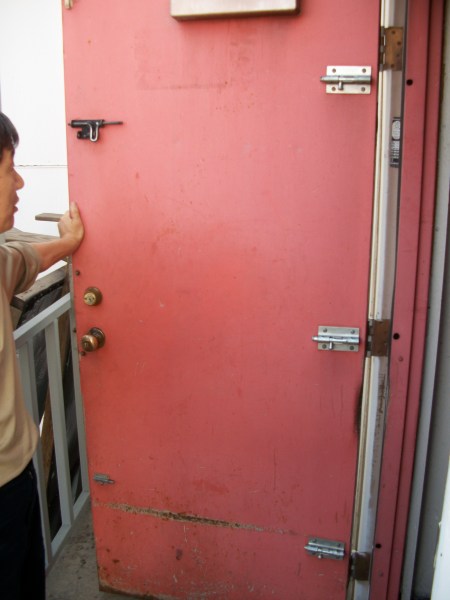
Outward swinging metal doors can be defeated numerous different ways with the irons. The door we see below is showing our typical key in the knob lock with the common deadbolt above it. We also see a latch guard has been installed and a set of two small bolts higher up to door that could be a smaller gauge secondary lock.  This picture is a door where I have heard people say go straight to the saw and the hinges. My personal belief is that an irons team with a game plan and solid irons work will defeat this far before a saw will.

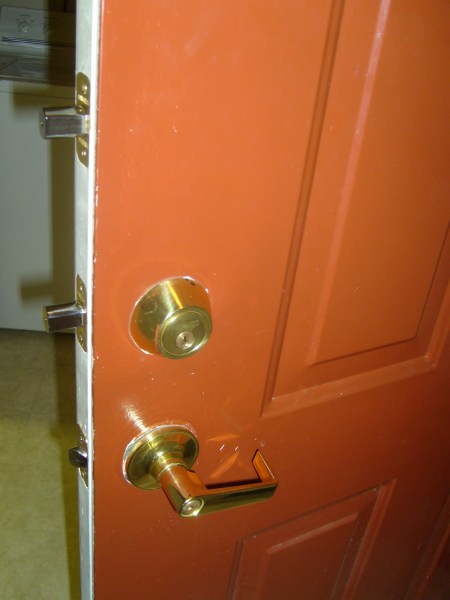
Then take a look at the interior picture, it is a great example of a setup that will make the hinge side that much worse. We have a video we will post on here fairly soon showing numerous different ways of conventional irons work with different lock setups.

Fine Tuning Your Halligan

Posted 08/08/2010 by IRONSandLADDERS
Categories: 1. Forcible Entry

Tags: , , , ,

                           By R. Royal

 The Halligan (Pro Bar)  is hands down the most important and versatile forcible entry tool we carry on the rigs. We have had a few different articles on this website regarding the Halligan, some about the differences between the Pro Bar and its imitations, also understanding the advantages of bevel to the jamb, versus bevel to the door during inward swinging forcible entry operations. This next article is to discuss a few little modifications that can be done that make this tool even more superior.  

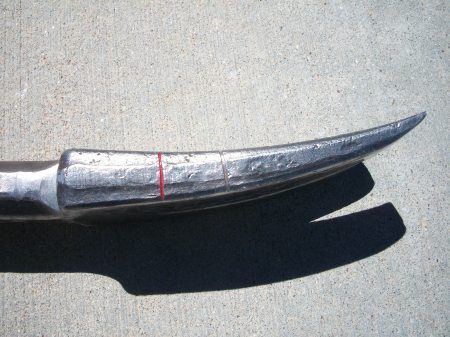
The first two improvements just assist you in seeing what you should be feeling when setting the tool. What we have done as seen in the pictures below is scratch a small thin line and add some drops of red paint to show our proper depths when setting the tool. After enough practice with the tool, setting to the proper depth should come  just by feel, but adding these marks just makes it that much easier.

The first mark we have added is on the Adze end. This mark has been scratched in at about 1 3/4. This is the standard width of commonly found doors, by making this mark it will assist us in knowing when the adze is about to hit the jamb on outward swinging doors. This can assist us in navigating the Adze around the back of the door and not tearing into the jamb. It also can prevent us from stopping to shallow and then tearing the skin and seam of the door when we start to make our gap.

The second mark is made on the fork end and is used for inward swinging doors.  This mark has been made to show where the “crotch” of the fork is. As you can see in the picture the crotch is where the two forks come together and meet. We want to make our marks on both sides lining up with the crotch of the fork. This landmark comes from the term “crotch to stop”. Basically our tool is set to the proper depth when this “crotch” or red mark has lined up near the back of the door stop or jamb. This can be very helpful to prevent you from stopping to shallow, or going to deep when the Halligan is being driven in very quickly. If we drive it in to far we lose a large amount of leverage when we go to force. When it is stopped to shallow, it becomes very easy for the forks to slip out when you force the bar. Again this just makes it a little easier to see, and is a very big aid in teaching the concepts of crotch to stop.

The next two pictures below show what should be  necessary maintenance to the tool. The next step is a very slight change but goes a real long way. I think this is the number one improvement you can make to this tool. This may be difficult to explain through writing, but we will give it a shot. When the Halligan comes from the factory the ends of the fork will have a bevel to it. It is a dull bevel and is in the center, on the tip of these forks. What we have done is filed down the ends of these forks slightly, thinning them and giving the tips more of an edge. Instead of having the dull bevel in the middle of the tips, they come to a clean edge on the inside of the bevel.  This makes a huge difference on inward swinging doors that are set very tight to the jamb. It will make enough difference that the clean edge will probably bite and start to navigate around the door whereas the old bevel may tend to bounce off many times.

Lastly we have the squared shoulders of the fork. When the bar comes from the factory it has a small curve from the handle into the forks. What you can do is file down the curve into a nice right angle like you see here. This has created a new striking surface that we can use when alternate techniques are required. Such as tight hallways or cellar entrances, low visibility, or when there is only ne firefighter available to start forcible entry,  this small change allows that to happen. This will enables one guy to effectively get started doing both the striking and the Halligan work on a door (which we will hit on a later date).

You can find numerous different improvements out there that have been done to these tools, we feel these are the most advantageous for what we do and really can make a difference in how they perform. Like many other articles on here, again we say we didn’t invent this stuff, just feel it is worthy information that should be passed on to those who wish to use it.

Burn…A look at Detroit Fire

Posted 07/21/2010 by IRONSandLADDERS
Categories: 7. Everything Else

Tags:

This was sent in to us by a few people, and it has been beginning to show up around the fire community. A few people had asked us to help spread the word and try to support the cause.  It is the story of what Detroit firefighters are dealing with on a day to day basis. The film team is trying to get enough support to film a year long documentary following one of their fire companies. The trailer below was filmed in only a few days, the video speaks for itself. Take a look.   

Vodpod videos no longer available.

Burn, posted with vodpod


More information can be found at www.detroitfire.org 

Door Size Up #5

Posted 07/11/2010 by IRONSandLADDERS
Categories: 1. Forcible Entry

Tags: , , , , ,

This door size up drill is a little different than most of the ones we have posted before. It points out more of a specific lock setup that we find on newer style apartments complexes. These are a great example why it is beneficial to take a look at doors as you walk through them on all the calls we have before the fires. 

You can see that the outside of the door only shows your typical handle and deadbolt setup. However once you open the door you can see that this has a second hidden deadbolt that is only operated from the inside. With a wood frame (as shown) this adds very little extra security due to the fact that the jamb is going to split and probably fail at the same time for both locks. However if this setup is found on a metal frame it may hold up better and add some resistence to the door that is not expected until we start our conventional forcible entry on the bottom two locks. Nothing too out of the ordinary here, just worth noting that they are out there and that we should always have plan A, B, C and so on.

Maybe the most important thing to notice about this type of lock setup is what it provides you for search information. This is typically found on apartments that have one door that is used for egress. If we force this in a fire and find that the top deadbolt is locked, we may have a real good indicator that someone is inside the unit. These locks, like security chains, can give us valuable search information if we pay attention to the details.

A Tip of the Hat….

Posted 07/04/2010 by IRONSandLADDERS
Categories: 7. Everything Else

A tip of the hat for those who are serving and have served this country…..thank you. Happy 4th.

Wire Cutters…What Works For You?

Posted 06/28/2010 by IRONSandLADDERS
Categories: 6. Building Construction/Hazards

Tags: , , , ,

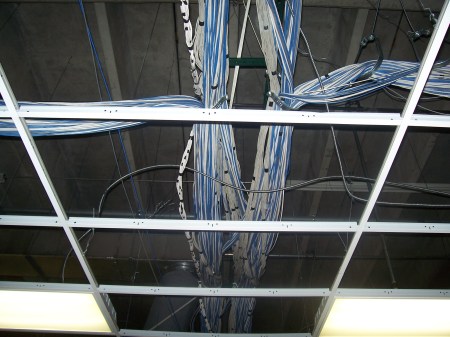
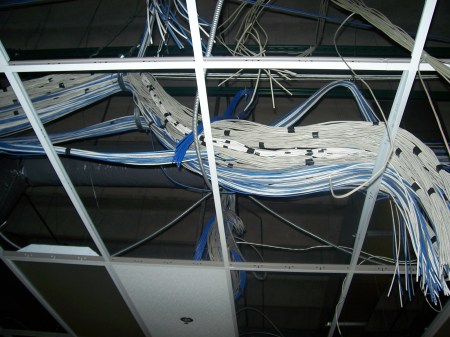
I came across these pictures that I had taken from a while back. They demonstrate a decent example of what we may find above our heads. There is always a lot of talk about carrying wire cutters, and these photos show a couple of examples of why we may need them. We had a good view of the void space above the drop ceiling in one of our local buildings. The amount of wires that are run above our heads is pretty unbelievable. This is what was above the ceiling and the bottom picture shows the pile that they had already removed. 

 Here is a picture of some of the most common cutters that are carried by guys. The bottom line is we will use these for all of the other utility work that we do and probably without ever using them for wires that are found in the ceiling. Obviously these all have advantages and disadvantages which is what we would like to hear. I am a big fan of trying things out, using them on real materials before ever counting on them to do any of your work. You have the heavy-duty cutters (pictured on the left) with crossing blades that will handle most gauges of wire with ease. Granted they may cost more, they are a bit bulkier and are usually a two hand operation. The second pair shown will not handle as many wires at once, but is spring loaded making one handed operation possible. The third pair can handle a large amount of wires and is spring loaded, but the drawback is the blade is much more fragile and easier to damage. Lastly the cheapest option is the shears that maybe laying around the storage room, they cut well and are a one handed operation but take a little longer to use when cutting the wire. I am not going to swear by one pair or the other but I do believe they are all worth a try to see what works for you. I prefer that they handle all of our wire cutting tasks, are easy to use and get to, and are fairly easy to replace ( I lose them more than not). What are your thoughts? What works for you?….

Ladder Rescue Mishap

Posted 06/17/2010 by IRONSandLADDERS
Categories: 5. Ladder Work

Tags: , , , ,

Here is an ugly one out of Europe I believe, judging by the PPE. I liked it because it is a scenario that any of us could face, and hopefully we can learn from this one to improve the way things go for us. I for one like practicing ladder work a lot, I feel it is the only way to keep sharp on placement and height. This is a great example of when you are only going to get one chance to pick your spot, and one chance to get the height right, because as seen here, when the ladder goes into the building the people are coming down (no matter how you placed it). I think some solid advice that I have been taught is go for a shallow angle over a steep one anytime you can. Obviously this increases the chance that the butt will slip, but if we have a guy to foot the ladder or are in soft ground then why not, it may just prevent us from coming down on our backs with a victim on our chest. Anyways, here is a quick take on what we noticed in this video.     

Once one thing goes wrong it all starts going down hill. You can see they come up short with the ladder and place it at a real steep angle. They go up to make the attempt anyways, right about the time the victim decides enough is enough and lets go. They still have one victim hanging (who has been hanging for a long time) who we can almost count on following suite with the first. To add insult to injury you notice one of the Engine guys stretching hose falls onto his back  over one of the Ladder guys that is lying on the ground. 

 Here is a little bit of the time breakdown: 
1:08 – Camera zooms back far enough you can see the fire on the far right..Do you think that is a stairwell due to the uneven window height?
1:20 – First victim falls (that is a long time to hold your body wieght….at least for me it is)
1:55 – 2nd firefighter starts to go up for the rescue, you can see him hesitate a few times, which makes me think he can tell they are about to fall.
2:00 – Engine guy falls over the injured firefighter, also the 2nd victim falls taking out another firefighter.   

Vodpod videos no longer available.

  What do you think? There is some good discussion points. Ladder placement, ladder height, smoke conditions, and fire location. Good video, I came across it through an email that one of the Brotherhood Instructors sent out (A. Brassard), thanks to him and whoever else had a part in getting this video out there.

Vehicle Fires….

Posted 06/07/2010 by IRONSandLADDERS
Categories: 2. Hose Work

Tags: , ,

We had a car fire a while back that presented a unique hazard. It was a good reminder that vehicle fires may not always be relatively uneventful and certainly have their own list of hazards. The problem we encountered was involving a newer style VW convertible bug. It was fully involved and seemed to have been torched by someone tossing something under the dashboard. The garage looked as if it was also becoming involved and an 1 3/4 was pulled. The problem arose while the hose was being flaked. Two small explosions occurred within the first few minutes. They were loud enough to catch your attention and sounded similar to when tires pop during  car fires. The first one was not much of an issue but the second one sent a fairly large piece of debris flying over our heads across the street and landed on the sidewalk on the opposite side. This was about 35 feet away from the vehicle.

When the fire was knocked down we discovered what the small explosions were. We found the entire airbag assemblies from under the dashboard had exploded and dislodged sending one across the street, and the other one was found a few feet from the car. It had the air bag, the mounting hardware and the gas cylinder all still connected as one large piece of debris that came out of that vehicle like a rocket. I am sure other people have experienced this, but I just wanted to throw it out there as a heads up because it is worth thinking about. Anyone had something similar?

Below are a few videos that I have saved over time regarding some of the other problems we may run into.

Thru-The-Lock Pliers (Modified Channelocks)

Posted 05/23/2010 by IRONSandLADDERS
Categories: 1. Forcible Entry

Tags: , , , , , ,

By  R. Royal

Here is a thought on one way to make your own pair of modified pliers. They save room in your pockets and are actually much easier to use then the commercially made “key tools”. They provide you with more control and more leverage when tripping locks after removing the cylinders. Obviously making these pliers is not a science but I have had a chance to make 35 or so pairs of these pliers and each time learned a few little specifics that improve them. I have had quite a few people email the website in the last few weeks asking for a post about fabricating these pliers.
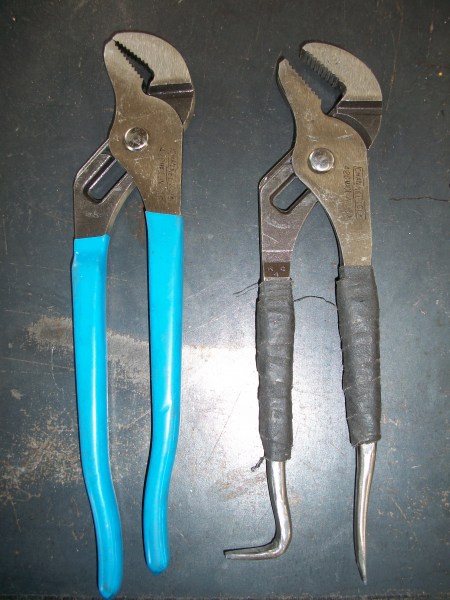
Above is  a before and after picture of the pliers we are going to make. I only use the # 420 Channellock Brand 9 1/2 inch slip joint pliers. It makes a difference to spend the 12 bucks and buy the quality brand pliers that will last forever. They are made with quality steel  and do not use a nut to hold together the handles. After you get your pliers we start our process by cutting off the blue rubber handles with a utility knife .

 Now you want to mark the end of the handle that you are going to bend. I have found that the best handle to bend is the longer (what i would call the inside ) handle. It fits better in your hand this way if you are unscrewing a cylinder and also improves the grip on the handle. Plus it keeps the handles pretty close to the same lengths when you are done. I mark the handle at 7/8 of an inch, anywhere within 3/4 to 1 inch should be fine but this has seemed to fit in the mortise locks the best for me. You want to mark the handle on a few sides so that you can see the marks when you are heating and bending the handle. 

Now we want to heat the handle. I am writing this based off of a small propane torch because it can be found in the firehouse. If you have an Oxy Acetylene torch you will make quick work of this step in about 5 seconds, but for everyone else we will go this route with the propane. The mark you made with the knife will be your vise mark. This is where we want to concentrate the heating. This process of heating the handle will take anywhere from 5 to 10 minutes depending on how efficiently you hold the torch. It is important to adjust the propane to a good flame and use the hottest part of the flame. Do not hold the torch to close, it will add a lot of time to your heating. You will see the coating burn off in the first few minutes and then eventually you should start to see a faint glow around your mark. Dont bend it right away, heat it for a  another minute or two to ensure it is hot enough.

Adjust your vise so that you do not have to turn it very far once you have your handle heated, you lose precious heat if you do not bend the handle very quickly after the heating. As you can see in the picture below the mark we scratched is not where the bend is, I line the teeth of the vise up on both sides of this mark, the bend should occur above the mark. It is important to bend the handle to the outwards position. If you look at the first picture you can see which way it bends. I have bent them inwards to make them more compact, the problem is it will prevent you from closing the pliers all the way and the jaws will not be able to grab many materials. It also makes it more difficult in the open position to use the bent end while tripping mortise locks. When you think you have enough heat stick the handle in the vise, line up your mark and then attempt to bend it to about a right angle. This should not be terribly hard to bend, if it is you have not heated it enough and may crack the steel. You will feel some resistence when it is heat properly but you should not have to put your weight into it.  

Next I like to take the two ends and  grind them roughly into shape, make sure you don’t go to thin because it is easier to clean them up and fine tune them with the angle grinder. It is hard to describe the size you want to make these end pieces, look closely at the next pictures for a design, but more importantly trying them in some common locks to make sure they fit all of them is important. I will do my best to give you some dimensions and the reasoning behind it.
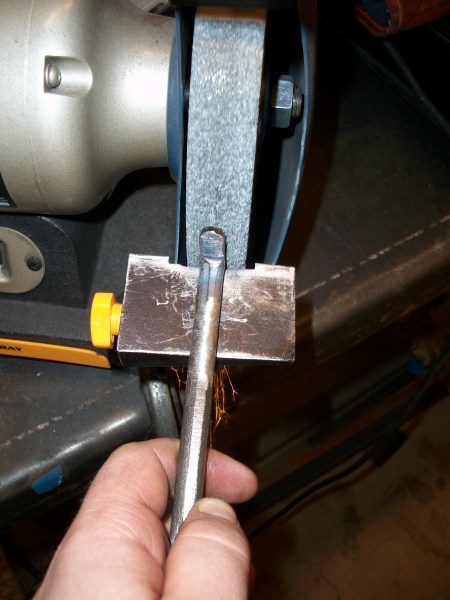
You can see below the rough shapes we are going for. The straight end is more specific than the angled end. If you roughly make the angled end about 1/8 inch thick at the end and tapered to about 1/8 inch wide you will be in pretty good shape. Just try the sizes in a standard storefront mortise lock. The straight end however has a lot of different locks it needs to fit into. If you make it the right size you can trip all of these locks with ease.  If you grind the end of the straight handle to 1/16 thick and 3/16 wide you will have the best all around size. This allows you to trip rim locks with few problems but also allows you to trip your most common tubular deadbolt throws. Many of these deadbolts have plus signs, stars, half moons and other odd shapes. The half moons can be the most difficult. The size that I gave you will fit all of these. The other lock that this thin straight handle will fit into is the “jimmy proof vertical deadbolt rim lock”. These have the self closing shutter that closes when you pull the cylinder. It is important that your handle can not only trip the shutter but also fit in the lock behind it and turn the bolt. Granted that is another story for another day.

These finishing touches and measurements are best done with an angle grinder that has a sandpaper wheel on it. They allow you good control over the material you take off and puts a nice shine on the metal. When that is done I like to take a quality roll of  friction tape and wrap a couple passes on both handles.
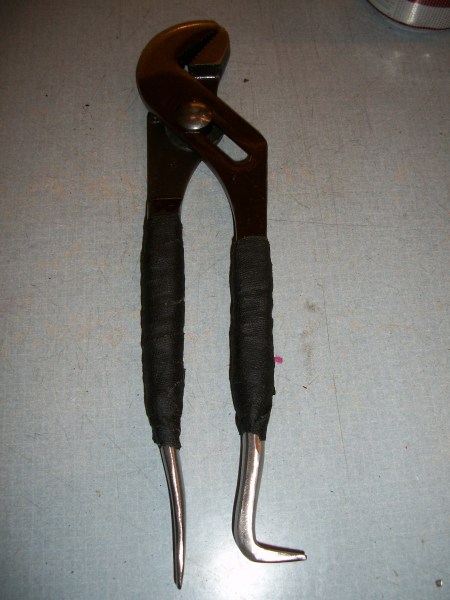
Now that you have a nice new set of pliers, you need to give them a try. There is no use making them if you don’t put them to work. Any other questions, let me know in the comments section and we will try to answer them.

May 30th Forcible Entry Class (UPDATE)

Posted 05/20/2010 by IRONSandLADDERS
Categories: 1. Forcible Entry

Tags: , ,

We have some spots remaining for the May 30th Hands On Forcible Entry Class. This is an open enrollment class and firefighters from any department are welcome to attend.  To register please email ironsandladders@hotmail.com, or call 719 660 4740. Time is running out so contact us soon.  Click on the flyer below for more information.