The second door we have is an interesting one. It is very obvious upon size up that we have multiple security features to this door (which is not always this obvious). Take a look and a guess…..then scroll down and see if you were in the ballpark.
Remember the key points to look at sizing up before you plan your attack.
- Building Occupancy (which we will give you)
- Construction type
- Which way it swings
- Type of door/material
- Type of jamb/frame material
- Locking devices and bolt patterns (primary, secondary and so on)
This door was found on the backside of a L-shaped 2 story wood frame commercial. The building has multiple storefronts, and many business on the second floor also. This specific unit was a large rental center and the tenant had multiple previous break ins.

And here is the first step of the interior.
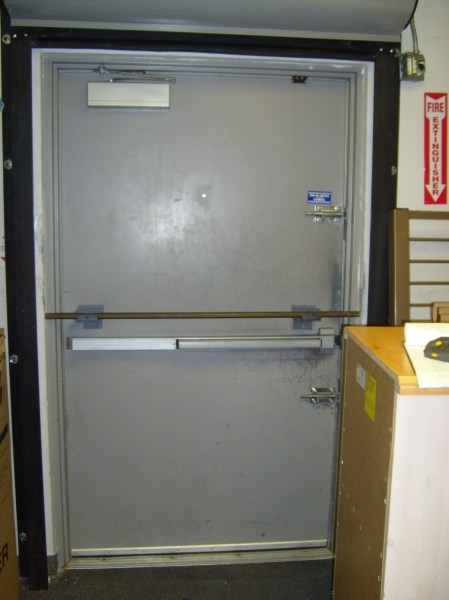
Just as you begin to think you’re getting a handle on the door you find this next.

What was the outside telling us??

Just walking up to this door we can see pretty obvious signs of heavy fortification. The numbers above go along with the following descriptions:
- We have a typical door handle and rim cylinder combination. This type of hardware showing, along with knowing the occupancy, will tell you this has panic hardware on the backside. This lock setup is not very substantial alone, and may be all that is holding this door shut if it is daytime hours.
- Next we have two sets of carriage bolts mounted right above the panic hardware setup. These bolts should tip us off to some kind of drop bar mounts installed on the inside.
- Third we have two sets of 4 pattern carriage bolts. One set up high and one down low. These more than likely tell us that we have either slide bolts into the jamb, or padlock hasps installed. The location of the bolts near the edge of the door and the pattern of the four bolts are what is unique to these types of setups.
- The fourth characteristic basically tells us they have fabricated something inside that requires heavy-duty anchors through the entire exterior wall. Untill you see the inside, you could be thinking a number of things.
How do we defeat this?
Many people give this door much more credit than it deserves. The doors looks impressive from the outside and has some great points for talking about size up, however this door can be handled with a set of irons and some assistance from the saw. It is going to take longer than some but is still very reasonable to make as an option on the fire ground. Don’t let the internet fool you, C4, trucks with chains, find another door or this is impossible are not viable answers.
- Start conventional, Gap Set Force. During daytime hours this door was regularly locked with just the panic door. If that’s the case we are in with ease. If it is all buttoned up the halligan will still expose the weak points and we can conventionally pry open every lock you see on the outside door.
- Pry near the primary lock and the drop bar bolts, this is a great starting point and will be defeated with a set of irons and a hook if needed. This will also tell us what else is locked on the door.
- Next pry near either the upper or lower set of bolts that is the slide bolt. These offer some decent resistance if they are mounted correctly but can be overcome with irons. If one is ever holding on a little better than normal, the 6′ hook as a cheater will destroy these.
- After that this door is open to the roll down gate. Remember if you have a running saw you can always cut the shafts of these carriage bolts to assist you with loosening everything up. I am not anti saw and would absolutely do this also, just know irons can get you in these basic locks. When using the saw make smart cuts, start with the bolts on the lock side, ignore everything on the hinge side unless it is needed.
- While we are working on the outside door, hopefully someone has sent for the saw by the time we get to the roll down door behind it. This is going to be forced by the saw much quicker at this point.
Check out our commercial forcible entry videos on you tube for detailed instructions on forcing this exact type of door.





 IRONSandLADDERS.com
Recent Comments