Archive for the ‘1. Forcible Entry’ category

Door Size Up #5

07/11/2010

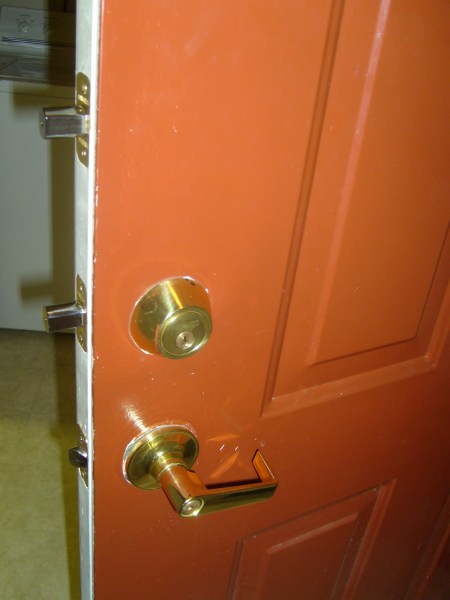
This door size up drill is a little different than most of the ones we have posted before. It points out more of a specific lock setup that we find on newer style apartments complexes. These are a great example why it is beneficial to take a look at doors as you walk through them on all the calls we have before the fires. 

You can see that the outside of the door only shows your typical handle and deadbolt setup. However once you open the door you can see that this has a second hidden deadbolt that is only operated from the inside. With a wood frame (as shown) this adds very little extra security due to the fact that the jamb is going to split and probably fail at the same time for both locks. However if this setup is found on a metal frame it may hold up better and add some resistence to the door that is not expected until we start our conventional forcible entry on the bottom two locks. Nothing too out of the ordinary here, just worth noting that they are out there and that we should always have plan A, B, C and so on.

Maybe the most important thing to notice about this type of lock setup is what it provides you for search information. This is typically found on apartments that have one door that is used for egress. If we force this in a fire and find that the top deadbolt is locked, we may have a real good indicator that someone is inside the unit. These locks, like security chains, can give us valuable search information if we pay attention to the details.

Thru-The-Lock Pliers (Modified Channelocks)

05/23/2010

By  R. Royal

Here is a thought on one way to make your own pair of modified pliers. They save room in your pockets and are actually much easier to use then the commercially made “key tools”. They provide you with more control and more leverage when tripping locks after removing the cylinders. Obviously making these pliers is not a science but I have had a chance to make 35 or so pairs of these pliers and each time learned a few little specifics that improve them. I have had quite a few people email the website in the last few weeks asking for a post about fabricating these pliers.

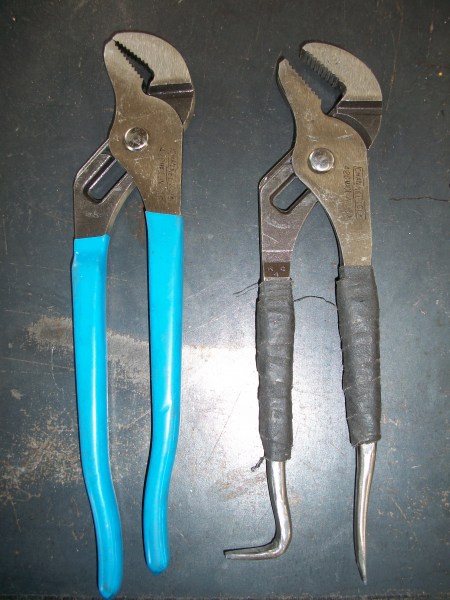
Above is  a before and after picture of the pliers we are going to make. I only use the # 420 Channellock Brand 9 1/2 inch slip joint pliers. It makes a difference to spend the 12 bucks and buy the quality brand pliers that will last forever. They are made with quality steel  and do not use a nut to hold together the handles. After you get your pliers we start our process by cutting off the blue rubber handles with a utility knife .

 Now you want to mark the end of the handle that you are going to bend. I have found that the best handle to bend is the longer (what i would call the inside ) handle. It fits better in your hand this way if you are unscrewing a cylinder and also improves the grip on the handle. Plus it keeps the handles pretty close to the same lengths when you are done. I mark the handle at 7/8 of an inch, anywhere within 3/4 to 1 inch should be fine but this has seemed to fit in the mortise locks the best for me. You want to mark the handle on a few sides so that you can see the marks when you are heating and bending the handle. 

Now we want to heat the handle. I am writing this based off of a small propane torch because it can be found in the firehouse. If you have an Oxy Acetylene torch you will make quick work of this step in about 5 seconds, but for everyone else we will go this route with the propane. The mark you made with the knife will be your vise mark. This is where we want to concentrate the heating. This process of heating the handle will take anywhere from 5 to 10 minutes depending on how efficiently you hold the torch. It is important to adjust the propane to a good flame and use the hottest part of the flame. Do not hold the torch to close, it will add a lot of time to your heating. You will see the coating burn off in the first few minutes and then eventually you should start to see a faint glow around your mark. Dont bend it right away, heat it for a  another minute or two to ensure it is hot enough.

Adjust your vise so that you do not have to turn it very far once you have your handle heated, you lose precious heat if you do not bend the handle very quickly after the heating. As you can see in the picture below the mark we scratched is not where the bend is, I line the teeth of the vise up on both sides of this mark, the bend should occur above the mark. It is important to bend the handle to the outwards position. If you look at the first picture you can see which way it bends. I have bent them inwards to make them more compact, the problem is it will prevent you from closing the pliers all the way and the jaws will not be able to grab many materials. It also makes it more difficult in the open position to use the bent end while tripping mortise locks. When you think you have enough heat stick the handle in the vise, line up your mark and then attempt to bend it to about a right angle. This should not be terribly hard to bend, if it is you have not heated it enough and may crack the steel. You will feel some resistence when it is heat properly but you should not have to put your weight into it.  

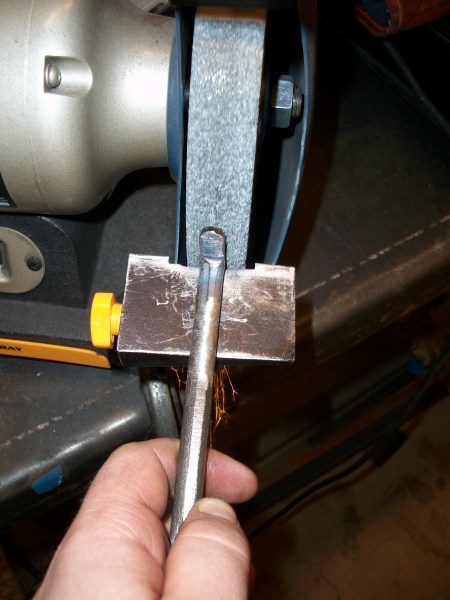
Next I like to take the two ends and  grind them roughly into shape, make sure you don’t go to thin because it is easier to clean them up and fine tune them with the angle grinder. It is hard to describe the size you want to make these end pieces, look closely at the next pictures for a design, but more importantly trying them in some common locks to make sure they fit all of them is important. I will do my best to give you some dimensions and the reasoning behind it.

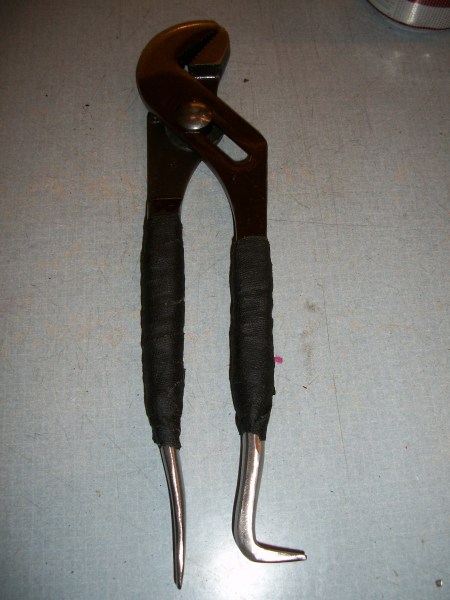
You can see below the rough shapes we are going for. The straight end is more specific than the angled end. If you roughly make the angled end about 1/8 inch thick at the end and tapered to about 1/8 inch wide you will be in pretty good shape. Just try the sizes in a standard storefront mortise lock. The straight end however has a lot of different locks it needs to fit into. If you make it the right size you can trip all of these locks with ease.  If you grind the end of the straight handle to 1/16 thick and 3/16 wide you will have the best all around size. This allows you to trip rim locks with few problems but also allows you to trip your most common tubular deadbolt throws. Many of these deadbolts have plus signs, stars, half moons and other odd shapes. The half moons can be the most difficult. The size that I gave you will fit all of these. The other lock that this thin straight handle will fit into is the “jimmy proof vertical deadbolt rim lock”. These have the self closing shutter that closes when you pull the cylinder. It is important that your handle can not only trip the shutter but also fit in the lock behind it and turn the bolt. Granted that is another story for another day.

These finishing touches and measurements are best done with an angle grinder that has a sandpaper wheel on it. They allow you good control over the material you take off and puts a nice shine on the metal. When that is done I like to take a quality roll of  friction tape and wrap a couple passes on both handles.

Now that you have a nice new set of pliers, you need to give them a try. There is no use making them if you don’t put them to work. Any other questions, let me know in the comments section and we will try to answer them.

May 30th Forcible Entry Class (UPDATE)

05/20/2010

We have some spots remaining for the May 30th Hands On Forcible Entry Class. This is an open enrollment class and firefighters from any department are welcome to attend.  To register please email ironsandladders@hotmail.com, or call 719 660 4740. Time is running out so contact us soon.  Click on the flyer below for more information.

May 30th Hands On Forcible Entry Course

04/26/2010

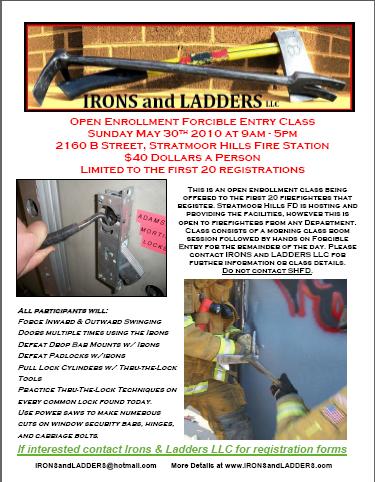
There will be a hands on forcible entry class on May 3oth. Stratmoor Hills FD will be hosting IRONS and LADDERS LLC. This is an open enrollment class for any firefighters interested and is limited to the first 20. Click on the flyer below for a larger printable version with all the details of this class.

For registration or more information email ironsandladders@hotmail.com or call Ryan 719-660-4740, Bryan 719-331-7284, or Nick 719-649-8060

Bevel to the Door vs. Bevel to the Jamb

04/05/2010

Bevel to the door or bevel to the jamb?…..that is the question. The main intention of this article is to compare the differences in the two ways the fork end of the Halligan can be used on inward swinging doors. Both ways can be used  with very effective results, but knowing why we choose to use one way or the other is important. They both have advantages and disadvantages, but as long as we recognize these advantages and use them in conjunction with each other it makes for a great combination. For clarification we refer to the bevel as the outside of the curve, it will be much clearer when looking at the pictures. This comparison applies to Pro Bar Halligans, although some of the info will pertain to other bars, it is written based of the use of the Pro Bars.

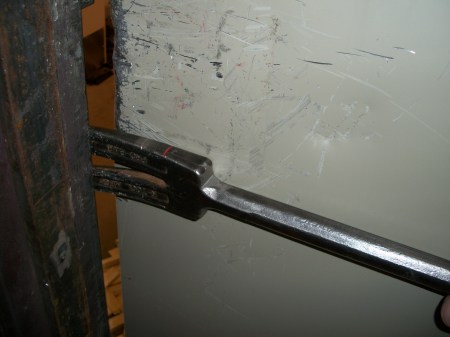
After we obtain a proper gap of the door(  based on wood or metal jambs) we must move to our fork and choose to either place the bevel to the jamb (as seen below) or bevel to the door. First we will cover bevel to the jamb. Bevel to the jamb allows us a few advantages when setting the tool to the proper depth. As you can see below the angle of the fork wants to naturally guide itself around the door. Because of this angle it leaves us with much less resistence on a metal frame, and it also helps prevent us from sinking the teeth into a wood jamb. While guiding our bar away from the door while it is being struck we keep the fork moving smoothly around the door. Our disadvantages come after we have the tool set and we are ready to force. This will be discussed below. The next two pictures show the fork being set with the bevel to the jamb.

Next we have Halligan being set with the bevel towards the door. This is probably the most common way setting a Halligan is taught, which is fine as long as we know the potential problems we have to overcome. You can see the curve of the tool is wanting to guide the forks into the frame. This can cause us to feel more resistence when it is hitting a metal frame, or creates much more of an oppurtunity to drive the forks into the jamb if it is wood. The Halligan firefighter has to pay complete attention to guiding the forks in to prevent us from hanging up on the frame. Solid pressure on the tool away from the door as it is being driven is a must to allow it to sink easily to the proper depth.  This is the disadvantage of setting the tool with the bevel to the door but the advantages come later. The next two pictures show the halligan being set with the bevel to the door.


If we haven’t lost you to boredom yet, we can now see the remaining advantages and disadvantages. As you see below we are back on the bevel to the jamb. As stated above the bevel to the jamb is easier to set and guide around the door to the proper depth. Where the disadvantage comes in is when we apply the force. The picture below is showing the Halligan applying full force. You can see that the gap it has created is relatively minimal. This is because we are not using the designed leverage point of the Halligan and we have also gone against the design of the forks. This still does not mean this way is wrong because many times this is all the leverage we are going to need, however we need to remember that the Halligan provides more leverage in other ways if it is needed.

The last picture(above) shows us bevel to the door being used. If you scroll back and forth between this picture and the one above it you can see the difference in the gap. We stated earlier that the bevel to the door can be more difficult to set if the door is tight, but as you can see when the bar is set it applies much more leverage. When the bevel is placed to the door it uses the characteristics of the tool to their full potential leverage. The forks grab hold of the backside of the frame and the high point of the bevel is being pushed against the door.

In summary neither way is right or wrong as long as you know why you are placing the bevel the way you choose. Different doors, jambs, and lock setups will call for different ways to put the bevel. A metal frame and metal door that is secured very tightly may call for the bevel to the jamb so that you can set it easier. However if we choose bevel to the jamb and don’t get the leverage we need, we can put a chock in the door or an axe and hold the gap we made. We can then pull the Halligan out and reverse the bevel and continue applying force with the bevel to the door.

This can go on and on, but it is only intended to illustrate the major differences in how you place the bevel. We know this is getting technical, but practicing the different ways regularly makes it become second nature on which way to place it. Again this is just another back to the basics post, nothing new, nothing that we invented. Just passing on great technique tips that has been passed on to us.  After this long-winded writeup there is really a simple way to sum it all up:

Bevel To the Jamb= Easier to set, Less leverage to force

Bevel To The Door= Harder to set, More leverage to force


Door Size Up #4

03/26/2010

This version of the door size up series is a little different than our previous ones. Below we have multiple doors that have a few things in common. Sometimes the most important part of door size up is recognizing when to move on to another door. Obviously some buildings may have all of their doors that are equally secured and they will all give you trouble. However some doors like the ones below would have been your worst choice to start your forcible entry operations.

These doors all have signs telling us that they are not used very often, or not at all. If they appear they have not been used in years, there is probably a reason. Sometimes we just have to trust what the size up is telling us and move on. Here are the examples.

Door  1

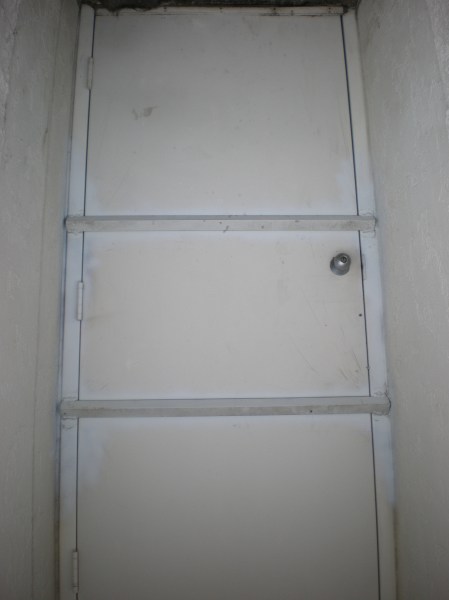
The first door has obvious signs on the outside that it is not being used any more. You can see it has two pieces of steel welded to the frame, covering the outward swinging door. The other side of this door has been covered and walled over. In the lower picture the door would have been behind the shirts that are hanging.

Door #2 

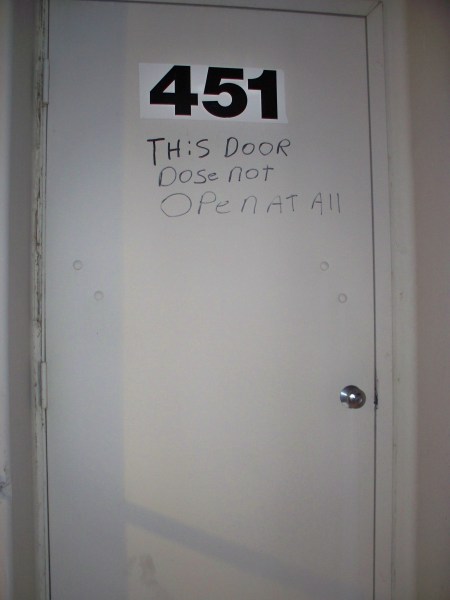
This door would have appeared to be pretty straight forward from the outside and has common security features showing. Luckily someone tried to warn us on the door that this is a poor choice to make entry. I am glad to see someone else spells like I do. The door you see in the interior picture is not the one we are looking for. The door we are sizing up is actually behind the shelves containing the cups and bowls.

Door # 3

Lastly we have an aluminum stile storefront door that has become a blockade. This was a side entrance of the building and is obviously rarely used, if at all. This would be easy to identify unless smoke had stained the windows, but it shouldn’t take us long to see this one isn’t a great choice. Could we get through these doors?…..Sure we could eventually, but on these particular buildings it would not have been the best choice, and it means we failed to notice key size up points that would have clued us in to their potential difficulty.

Thanks goes out to our fellow “South Siders” from Engine Co 11 for some of the photos and insight for this post.

Thru-The-Lock Tool Review

03/19/2010

You can find a variety of thru-the-lock tools out there, they come any many different sizes, names, prices, and most importantly quality. This is a quick review on the differences in the tools and their limitations. We thought this would be a good way to start before we post some thru-the-lock articles later on down the line. Some of these tools differences are so slight they are hard to spot until you take a close look at them. To start you can see the first picture that gives us a look at the most common thru-the-lock tools.


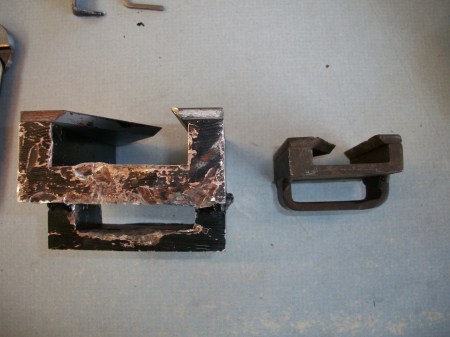
We will start with some of the oldest generation of commercially sold lock pulling tools. The K-Tool was invented in the 1960’s when thru-the-lock entry was just becoming an option. Many of the oldest thru-the-lock tools were homemade out of modified pry bars. The increased security features being installed on doors is what drove the original thru-the-lock tools. The K-tool is still an effective tool but has a limited use which is making it outdated. This is due to tubular deadbolts becoming very common and the invention of newer lock pullers that can pull all cylinders. The K-Tool is limited to rim and mortise cylinders however it is very effective  and portable which has allowed it to perform for many years on these types of locks. The body of the K-tool is too shallow to fit over the common tubular deadbolts found today. That is where the R-tool comes in, the R-tool is essentially a bigger version of the K-tool. It has the same design and pulls cylinders in the same way. However with the larger body it can fit over the tubular deadbolts also. The biggest drawback of this tool is the size. It is very bulky and is difficult to get around cylinders when they are close to the jamb or covered by handles.  They are also much less portable due to their size. If you look below you can see the difference in the depth of the tools body.

Below you see the Rex Tool and the Modified Rex Tool. These are some of the newest generation of lock pulling tools and in my opinion are the best ones you can use today. Because of their design you can pull any type of cylinder and also pull door knobs. Its slim design lets you reach locks that are under door handles or close to jambs.  The Rex-Tool is a great design and very effective tool however to take it one step further is the Modified Rex Tool.  The Modified Rex Tool is simply the cut off head of a Rex-Tool that has had a band welded on it. The band is made to fit a Halligan and is used in a similar fashion as the K-Tool. This makes it very portable and just as effective. It is simple to make and will be used much more because of having it with you and not having to go back to the truck. We have used it numerous times and had great success with this modified tool.

It is important to note that although the Rex-tool looks like the A-tool or O-tool (which we do not have pictures of) there is a big difference in their construction and how effective they are. You must look closely to tell the difference in the Rex-tool and the A-tool. Here are the main differences. The A-tool came out first, and they look like the Rex-tool having a handle that is connected to a head in the shape of a claw. The heads are smaller than the Rex-tool and have much less material that goes around the lock cylinders. The A-tool tends to slip easier when pulling cylinders and is difficult to use on tubular deadbolts compared to the Rex tool. The Rex tool  is  more expensive than the A-tool at almost double the price, but worth it for the way it performs. The easiest way to identify which tool you are buying or already have is by the shape in between the forks. The A-tool is like its name in the shape of an A. If you look at the picture above of the Modified Rex Tool you will see its signature shape is the U. This tapered U shape is a big reason the Rex-tool seats in locks so well and holds on while you pull. There are many other features that make one or the other better which we wont get into right now, this post was mainly to make it easier to identify the names and features of these tools. A quick note on the key tools and modified pliers. These perform the same functions of tripping the locks after we have pulled the cylinders. The advantage of the pliers is that you always have them with you. Many times the key tools will disappear out of the factory case they come in. The pliers are easy to make (which we will cover in another article) and work very well.

You can get into a lot more depth about these tools but that’s easier to do when explaining how to use them. This is just a way to get your terminology straight and recognize some of the differences between the tools. There are many other thru the lock tools available out there, but these are the most common. All of these were made by guys that ran into problems and came up with a better way to do things.

Door Size Up #3

01/17/2010

Door #3 is found on the backside of a 2 story commercial building. The front side consists of storefronts on the first floor with offices on the second floor accessed by a common stairwell. Attention to detail while sizing up this door may just make the difference in how we would attack it. Hit our key size up points, take a guess on the exterior picture and then scroll down to see if you were right.

Key points to identify for door size up:                                           

–          Building Occupancy

–          Construction Type (mainly the wall around door)

–          Which way the door swings

–          Type of door material 

–          Type of frame and jamb

–          Locking devices and Bolt patterns (additional security devices)

Exterior of Door # 3


Interior of Door #3

The interior picture makes it clear why the offset bolts are mounted as seen. This homemade multi-lock has a single handle in the center that slides the flat throws into place on each side of the frame. The throws sit  into the jamb and are then pinned behind the mount. This would prevent someone from reaching through a cut hole in the door and activating the handle. Another option found on this type of lock uses padlocks in place of pins.

The most common type of multi-lock in this area are the homemade ones as seen above. The commercially sold Fox Locks that activate in the same manner are uncommon in this part of the country. A big difference in these homemade multi-locks and the commercially sold ones is the access from the outside. Most multi-locks that are commercially made have the option of a key cylinder on the outside that allows you to activate the lock (which gives us the option of thru-the-lock), very rarely does a homemade multi-lock have this option.

Here is the breakdown of our size up:

1. The common door knob showing (key in the knob) tells us that we have very little resistence in our primary lock and that this door does not have panic hardware.

2. The offset carriage bolts should alert us of a possible multi-lock instead of a drop bar that is found so commonly on the backside of buildings. This is where the attention to detail comes into play because it would be very easy to assume a drop bar setup.

Halligan bars….they are not the same.

12/28/2009

The Halligan Bar

By Ryan Royal

In any profession, how well you know your tools directly reflects in the way you use them. A well made tool has obvious design and durability advantages in comparison to the cheaply made imitations. This is true with anything from channel locks to Halligan bars.  A well made tool is typically easy to identify if you pay attention to the details. Sometimes the fire service will sacrifice quality for price. This seems insignificant at the time, until we call upon the tool to perform.  Very rarely will a good mechanic settle for a cheap set of sockets, or a seasoned electrician use a set of discount lineman pliers. It is our responsibility as the grunts, the ones who will have the most hands on time with the tools to educate ourselves in the quality that they are made. If we are carrying sub standard forcible entry tools, the only way we can effect change is to be educated in their differences.

What we call the “Halligan Bar” has transformed through the years into many different variations. The original tool was made by Hugh Halligan in the 1940’s. This tool was an in-house invention and maybe the most widely used tool in the fire service. Hugh Halligan also invented the Halligan hook (also commonly known as the roof hook). The whole history of these tools can be an entire article in itself, but a major point to take from this is two of the most durable and useful tools still used today were developed by some creative firehouse ingenuity. Developed by problems that were identified on the fireground, taken back to the firehouse, and solved by a man who designed every specification for a reason. The problem with many of today’s different types of bars is they have varied from the specs of the original design in a negative way.

The tool that has stayed most true to the original specs and has actually improved on them is the Pro Bar. The Pro Bar has numerous advantages over its competition which are poor imitations of a Halligan. We will discuss some of the key points that make the Pro Bar superior as they relate with the following pictures.

The picture above shows you an overview of three types of “Halligans”. The Pro Bar (the upper most) is one piece drop forged steel, no parts to fail and at 30 inches is the perfect length. The other two are longer and are made by three pieces attached together. The details can be seen better in these close-ups. Many people buy a 36″ bar because they want extra leverage, however the 30 ” bar has plenty of leverage to defeat very fortified doors but will also fit inside of most standard door frames, something that the 36″ bar may not be able to do, but instead will hit the wall when you apply the leverage.

                                                                                                                                                                                           PICTURE 1 – (The Pro Bar fork is on the right)

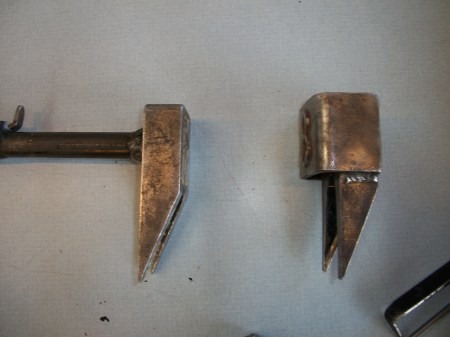
(PICTURE 1)  This picture of the forks shows you the big differences between the fork end of the bar. You can see the one piece construction of the Pro Bar on the right and the two imitations on the left.  As you can see, the three piece bars have been attached by a pin, and/or a weld. You can also see the tapered V shape of the space in between the forks of the Pro Bar. This angle of the fork gives you a good design to slide over hinges and take a solid bite to keep the bar in place.

                                                                                                                                                                             PICTURE 2 – (Pro Bar fork is on the right)

(PICTURE 2)  The side view of the forks shows one of the most critical differences in the bars,  the difference that makes the Pro Bar the well designed tool. You can see the Pro Bar has a nice gradual curve of the forks to give you the leverage you need once the tool is set. The key advantage is how much thinner the forks are, this allows you to set the tool on those tight inward swinging doors/jambs. The other two bars have an obvious thickness to them that adds to the problem of what we are trying to defeat. Why would we want our tool to work against us? If the door we are trying to defeat is worth its weight, then we are going to want the thinnest possible fork to drive in between the door and the jamb. The well designed curve is what gives us the leverage not the thickness of the fork. If the fork is too thick we will not be able to set the tool deep enough to even apply the leverage.

                                                                                                                                                                                PICTURE 3( Pro Bar adze on the Left )

(PICTURE 3)  The last picture shows you the adze end of the tool. The adze end could be the most useful part of the tool, especially if you are using one-man techniques. The Pro Bar adze is longer than the imitation bars and has a gradual curve to it. The curve gives us a high point on the adze that creates more leverage then its flat competitors. The length of the adze also gives you an added reach when you begin to pass it by the jamb of outward swinging doors.

The other part of the adze end of the tool is the pike. The pike is difficult to see in this picture but the differences are obvious if you have a chance to look at them in your own firehouse. The pike of the Pro Bar has a gradual curve to it, and is also much thinner then the imitation bars. The thickness of the other pikes is a disadvantage because of the resistance they cause when you need to drive them into material. The Pro Bars thin pike makes easy work of driving it through a metal door. This becomes very important if you are attempting to defeat carriage bolt heads with your irons. The less resistance the better and that is what the Pro Bar provides.

Nothing in this is new, like many things in the fire service, it is tried and true knowledge that has been passed down to us. It is important that this information is passed along so you can develop your own opinions, with that said this is an easy and obvious opinion to form for anyone that has been using Pro Bar Halligans.

Check out these old pictures from the original Halligan ads.

EDIT:   Right after posting this I was talking to Andrew Brassard from Brotherhood instructors. He also just wrote an informative article on this topic. We must have been thinking the same thing for a holiday article, both of these echo each other. Please take a look at his to reinforce what was said in this article. They also have a great picture of a three piece bar that has failed.Here is the link……Thanks Andrew for the heads up.

Next Up:  Modifications and Alternate uses of the Halligan
Residential Rolldown Security Shutters

12/14/2009

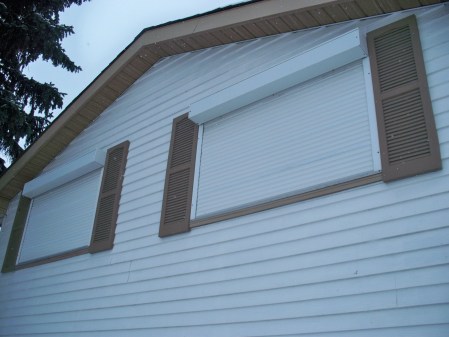
These are fairly unique on residential homes in this part of the country, but we have noticed a few popping up in our still district. I would imagine these are much more popular in the coastal parts of the country where they protect homes from hurricane damage.

 After running an alarm in this house we were able to take a closer look at how they are setup and installed. The reason we are seeing them out here is for security reasons. The elderly lady that owns this house informed us that she has been robbed a total of 12 times over the years. She lives in this home on a fairly busy street in an area where break-ins are not uncommon. I got the feeling that she has lived here for a very long time, probably before the neighborhood had started to decline. To secure herself this is what she came up with.

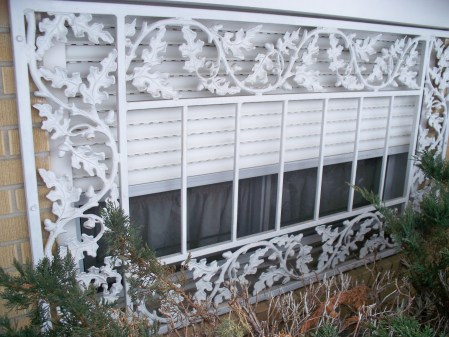
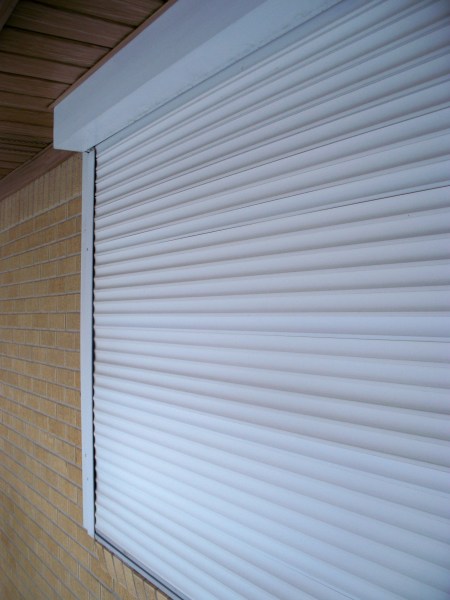
The pictures below let you see the roll down aluminum security shutters and the window security bars. What you cannot see by these pictures is that every window on her house, including the second floor have this security added to them. Not to mention the razor wire that has been installed on her fence that surrounds the backside of the house. Take a closer look:

The frames are installed as the top plate for the windows on the interior of the bars. However in the next pictures you can see that the metal framing for the shutters is more to the exterior of the building. Underneath you will find more window bars that are concealed behind the shutters.

These just add a curve ball into the standard ways we would perform horizontal ventilation, not to mention the work load that is added for the outside truck crew.  It also creates a great deal of egress issues. A few questions to think about.

How will this effect locating the fire from the outside? How long would it take a crew to remove, especially on the second floor?  Call an extra truck company?  Effects on smoke and fire behavior?