June 12th Cripple Creek Forcible Entry Class

Posted 05/13/2011 by IRONSandLADDERS
Categories: 1. Forcible Entry

Cripple Creek Fire and Emergency Services is hosting IRONS and LADDERS LLC on June 12th 2011. This is a closed session class for Cripple Creeks Reserve Academy. This class will be filled in house and should not have any other openings. If some arise we will post it for anyone interested.

Door Size Up #10

Posted 05/03/2011 by IRONSandLADDERS
Categories: 1. Forcible Entry

Tags: , ,

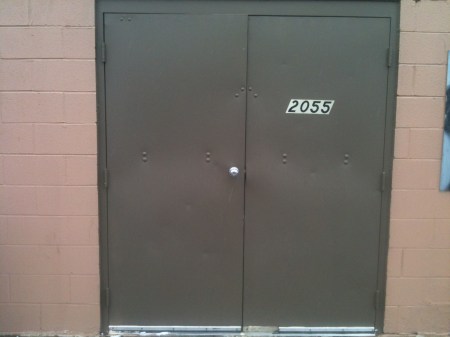
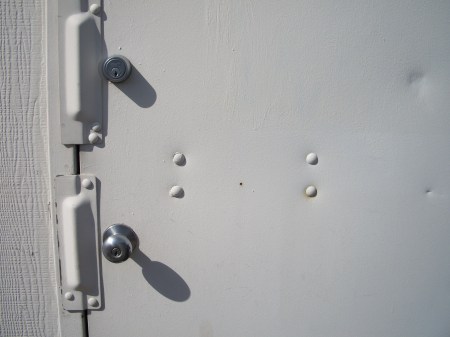
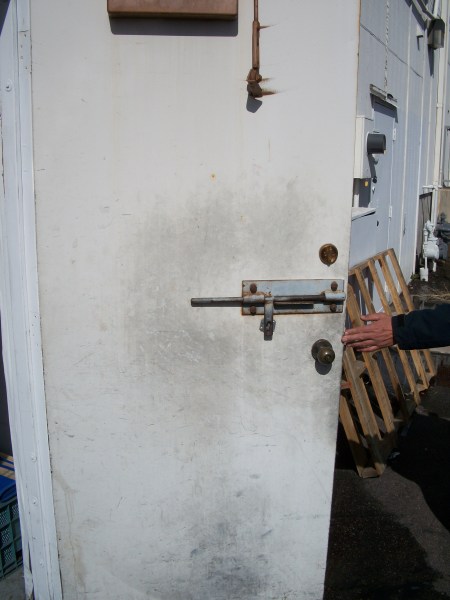
This door is on the backside of a single story “L” shaped strip mall.  The store is used as an army surplus outlet.  Run down the key size up points and see what you think. The double doors are set in masonry construction.  What else do we see?

  1. Metal frame and metal jamb
  2. Outward swinging double metal doors
  3. Primary lock is key in knob
  4. Carriage bolt pattern on both doors indicative of a drop bar
  5. Carriage bolt pattern 18” above the lock suggestive of a hasp or possible slide bolt

The interior view of this door shows us what we are up against.  As we predicted we have a key in knob lock and a drop bar with a hasp that is padlocked.  There are several interesting points about this door.  As we could tell by the exterior picture, the seam where the doors come together has a wide gap (approximately 1/2”).  The occupant has attached a 1/8” piece of steel that runs the length of the doors to prevent anyone from trying to lift the drop bar out of place or manipulate the primary lock. These strips on the back of the door come standard on many double door setups, but many times occupants will fabricate their own to increase the security. This is the main reason you should force the lock side door when doing double doors. You want to force the one that closes last because that metal strip acts as a stop for the main door. If your pry on the secondary door you will be working against that strip.   Secondly, the drop bar is 1/4” steel that rests on two brackets on either door.  The weight and placement of the drop bar will be beneficial to us when we start to force entry.  The weight of this bar could be an advantage as we drive the carriage bolts through because it may cause the brackets to fail even quicker. Another thing to remember on double doors is to force the bolts on the primary door first, don’t waste your time taking all the bolts out across the whole door because it is not needed.  Also, note where the drop bar ends.  It only extends the width of the frame, greatly decreasing the degree of difficulty.  Lastly we have the hasp that is padlocked together.  This may offer a little more resistance because the lock is elevated slightly and will cause us to lose a little leverage when we force the door.  It should not be anything that we can’t overcome using the irons.

Upcoming Classes and Training

Posted 04/24/2011 by IRONSandLADDERS
Categories: 7. Everything Else

We wanted to catch everyone up on some class and training opportunities from around the area.

First the Two Knuckleheads have their next presenter only a few weeks out. On May 16th John Ceriello will be presenting a class on “Todays Fire Attack and Ventilation”. This should be a great class that brings a good mix of street experience mixed with research findings on some of the most highly discussed topics in the fire service. You can visit the Two Knuckleheads website ( http://www.twoknuckleheadfiremen.com/ ) to obtain more information about this class or the others that these guys have planned. A job well done by these guys that have put a lot of their own time, energy and money into making these classes happen. You can also read more details or feel free to print off the flyer for this class found below. All registrations or further questions should be directed to the twoknuckleheads@gmail.com
                                                        May16 Flyer[1]

We here at IRONS and LADDERS LLC also have some more hands on forcible entry classes scheduled and in the works. We just finished a successful conventional forcible entry class at Pikes Peak Community College where we were able to run their entire Firefighter 1 Academy through the full day course.
We will be visiting Cripple Creek, Colorado on June 12th for a full day hands on forcible entry class as well. This is a closed session course for their Academy of new recruits along with some current firefighters.
Keep your eyes open for a date to be set in the Teller County, Colorado area for this summer. This will be an open enrollment class for that area hosted by the North East Teller County Fire District. We will have more information, a date and sign-up information for this class within the next week or so.
We also have two other classes in the works and will release the information on them once we get final commitments from these departments.
Thank you all for your support.

Mortise Cylinders V.S. Rim Cylinders

Posted 03/16/2011 by IRONSandLADDERS
Categories: 1. Forcible Entry

Tags: , , , , ,

There are a wide variety of different types of mortise locks and rim locks, found on both residential and commercial doors. It would be impossible to cover all of the different types of these locks and their variations in one article. 

 However these locks have something in common. They are very routinely mistaken for each other when someone is practicing size up on these doors. Now there are many key features that can be studied and identified from the outside that would allow you to identify them far before you pull the cylinder. It does take some practice and attention to detail to pick up on these, so that you can efficiently identify them a majority of the time. We may make that an article for another day, for now we feel it is important to cover the bottom line of what needs to be identified to get in these locks.

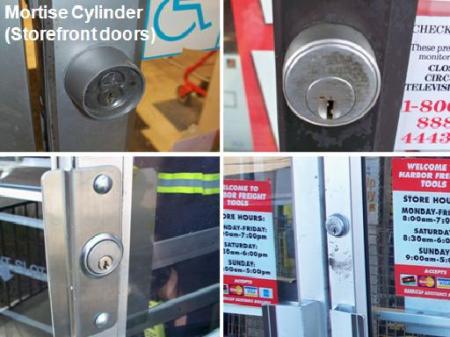
The above picture is a good example where we may run across these types of locks. This door has a mortise cylinder and a rim cylinder. The top cylinder is a dummy lock that does not operate anything. Since we have the luxury of glass and no conditions behind it, we can easily identify these locks. We see the bars across the door behind the glass which line up with the bottom cylinder. That is our indicator that this will be a rim cylinder operating a panic bar (rim lock). When we look at the cylinder above we can expect this to be our mortise cylinder which is more than likely set in a adams rite mortise lock with a deadlatch. This is the most common lock found in these doors, and if you only have one cylinder showing it is probably this type of lock.

If we decide thru-the-lock is the tactic of choice and we decide to pull the cylinder, there are a few things for us to look at. If we did not know what type of lock we were dealing with before we pulled the cylinder, we can immediately identify it after it is removed. By taking a quick look at the cylinder it will inform us of the type of lock we are going to trip and what end of our tool we will need to use (Either the angled end or the straight end).

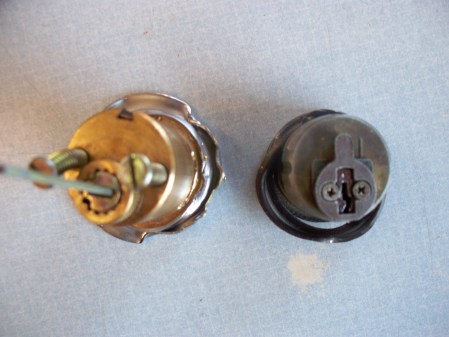
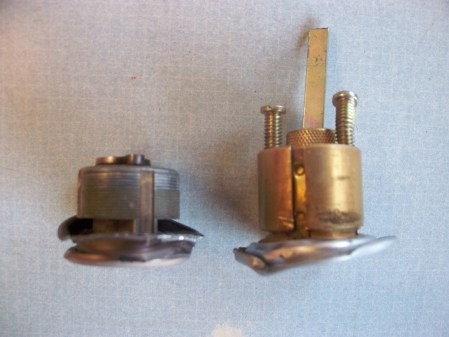
Pictured above are the two types of cylinders, the mortise is the dark colored cylinder and the rim is the gold cylinder. Even though these looked almost identical from the outside, you can now see significant differences. The mortise cylinder has the threaded body which holds it in place with a set screw whereas the rim cylinder has the two mounting bolts which connects to a thin metal plate on the back of the door. More importantly we can see the differences in their mechanisms. The mortise cylinder has the cam on the backside which rotates around as the key is turned allowing the small point on the cam to activate the lock. Next when you look at the rim cylinder you can see it has a stem which looks similar to the flat blade of a screw driver. This also turns and activates the lock. The main characteristic to remember from these above pictures is where the action of the lock is taking place. The mortise is activated downward and inside the door. The rim is activated straight back and on the backside of the door.

Here is a break down of each cylinder and lock by themselves.

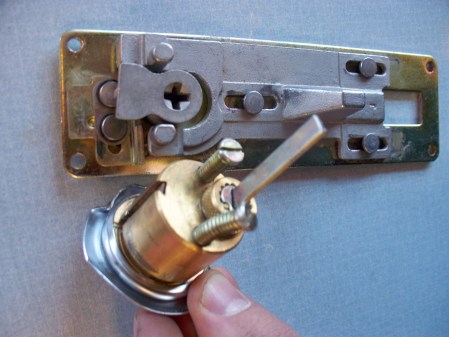
You can see the mortise cylinder next to the commonly found Adams Rite Mortise Lock. By recognizing the previously discuss parts of this lock like the cam, we know we will be using the angled end of our tool to activate the pin below where the cylinder sat.
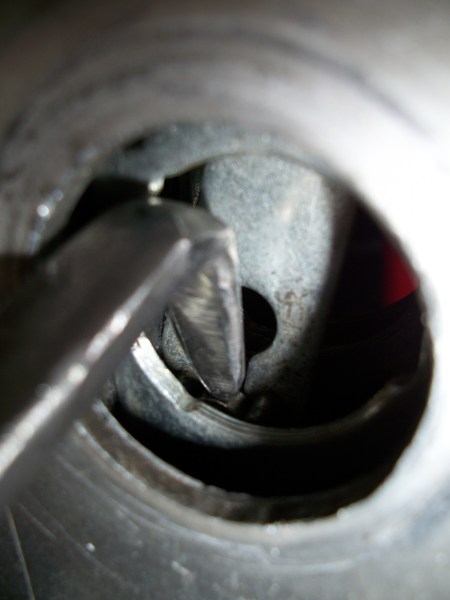
This picture is a good view of the mechanism behind mortise cylinders. A good landmark to remember is the open cutout on that arm that resembles a lightbulb. If you remember that cutout looks exactly like the shape of the cam on the back of the lock, and it also points to the exact spot we should place our tool to activate the button that can be seen in this picture. Once the button is depressed we will move the mechanism towards the jamb side of the door to release the latch. Not all mortise locks activate with the exact motion but a large majority of the do have a pin that needs depressed before the action can be made.

Next you can see the rim cylinder as if it had just been pulled.
 

The key points that we see here are the mounting bolts and the long stem. This reminds us that our lock will be activated straight in on the backside of the door. You can see the tell-tale plus sign on the lock, this is where the stem fits in to activate the lock. Many of these are simple quarter turn locks that is easily done with a flat screw driver.

These locks can be easy to over think, and sometimes you try and use too much force due to the small simple action that typically throws these locks. After you give the lock a quarter turn or until you meet resistance, try the thumb latch if it has one, or pull on the door to make sure you haven’t just unlocked the door but forgot to pull it open before the latch went back into place. This will tend to happen on panic hardware as the latch is more than likely spring-loaded in the locked position.

The bottom line out of all of this is: Rim = Stem= Straight end of the tool
                                                                        Mortise=Cam= Angled end of the tool

To wrap up we have a couple pictures showing you some different ways that mortise cylinders and rim cylinders may present themselves in the commercial setting.

Door Size Up #9

Posted 03/01/2011 by IRONSandLADDERS
Categories: 1. Forcible Entry

Tags: , , ,

Here is door size up number 9, Thanks to B. Lynch for putting this one together.

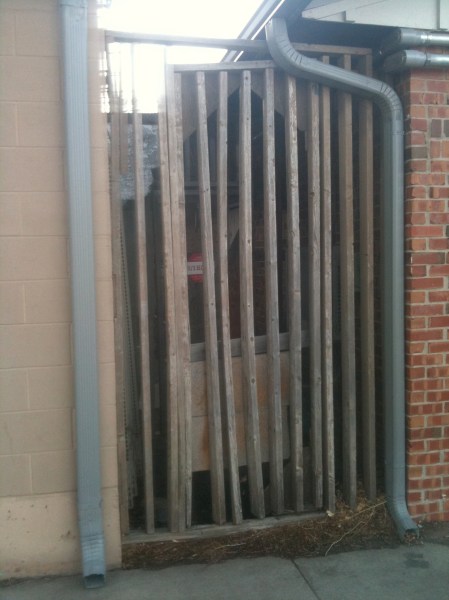
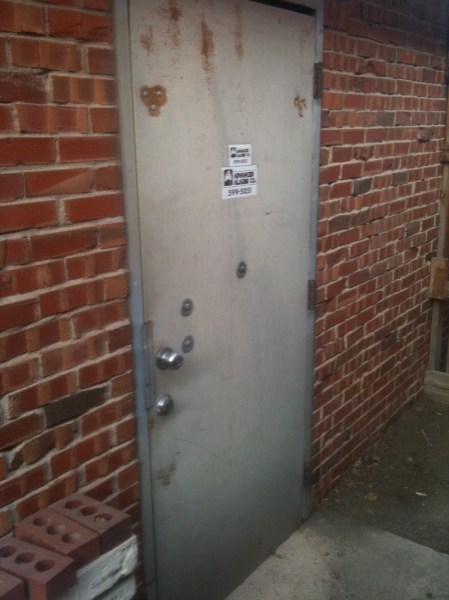
This door is found on the backside of an old single story convenience store.  The store has since been renovated and is now used as a Korean beauty supply shop.  We’ll give you a little information why this size up is unique.  The first is the issue of adequate space on the exterior of the building.  The store backs up to a strip mall and a bar.  There is a wooden fence and gate that is padlocked that accesses the rear of the beauty shop and bar.  There is approximately four feet of space between both buildings hence the exterior pictures had to be taken at an angle.  Run down our key size-up points and see what you think.

We gave you the construction and occupancy but what else do we see?

  1. Metal Frame and metal jamb
  2. Metal door
  3. Primary lock is key in knob with a latch guard
  4. Secondary lock is a commercial deadbolt
  5. The carriage bolt pattern suggests an additional locking device has been added.  The likelihood is small that this is a drop bar because of the unusual pattern of the carriage bolts.  However, in our haste to access this door we may mistake this for a drop bar.  Another note about the carriage bolts is the size of the washers behind them.  This will add difficulty in driving the carriage bolts through the door should we choose to employ that tactic.
  6. We also see slide bolt patterns in the door in three different places.  On the hinge side directly below the top hinge and on the jamb side about a foot below the deadbolt and about three feet above the key in knob lock.

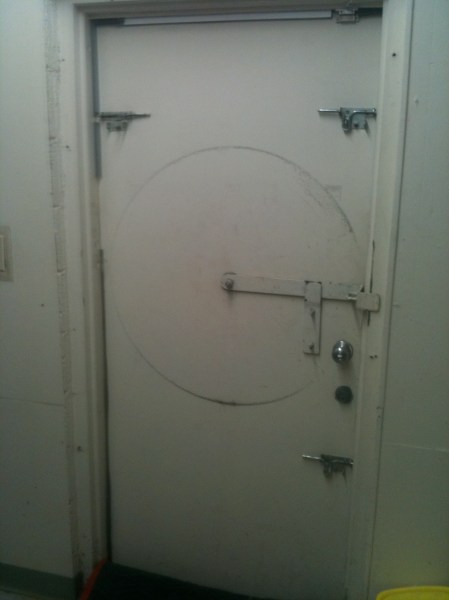
 The only real unknown we see is the unusual pattern of the carriage bolts on the exterior of the door.  Like we said before this could indicate the presence of a traditional drop bar with the two vertical bolts securing a bracket and the other bracket either welded to the door or the frame.  This doesn’t account for the carriage bolt mounted dead center of the door.  Taking a look at the back of the door reveals what we are up against.  As suspected we have a key in knob lock, deadbolt, and three separate slide bolts.  The unusual carriage bolt pattern on the front of the door is a modified drop bar.  The circular pattern on the door reveals how it functions.  The arm swivels and rests in the bracket.  It sits against the frame in an “L” shape and prevents the door from being opened.  

At first glance this door appears to be a formidable task.  Taking a closer look at the locking mechanisms reveals several things.  The slide bolts mounted near the top of the door do not match up with the holes drilled in the frame.  In other words they are not functioning locks.  The bottom slide bolt throws less than 2” into the frame and is held on by only two small screws.  This slide bolt will fail very easily with a little leverage applied via the Irons.  The latch guard, key in the knob, and deadbolt will be fairly easily and quickly defeated by the irons with basic techniques. If the slide bolt is not defeated by way of the conventional techniques on the jamb, we have numerous ways of defeating the carriage bolts either by irons or the saw.  The swiveling drop bar may be defeated be either attacking the lone carriage bolt in the center of the door or attacking the two vertical bolts next to the key in knob lock.  Either way this door will be defeated with by tried and true techniques and the Irons.

Great Fire Conditions Video

Posted 02/10/2011 by IRONSandLADDERS
Categories: 4. Ventilation

Tags: , , ,

This is a video I stumbled across on another great website the other day. Credit goes to www.fireservicewarrior.com for this post and find on the video. I thought it was definitely worthwhile to repost and see what everyone’s take is on it.

This fire is in Fairfax County Virginia. Three firefighters were hurt in this fire and a resident was hurt even worse. These videos have some great things for us to take away and learn from. Like many videos before, we are not here to bash other jobs. However discussion and comments about the fire and what we could have done, or what we learned from this video are always great. Anyone that has some thoughts should throw it out there for all to hear.

This is a very common building found in almost all of our districts. To stay brief I see to main points. The fire seems very under-ventilated and is screaming to get out. Second, possibly due to the first point there appears to be a delay in getting the first line advanced to the fire.

This shows some great fire and smoke conditions, and shows how quickly that dirty smoke will light up. The second video is the same fire, just later into the incident. It gives you a much closer view of the building and shows where the fire made it to.

Door Size Up #8

Posted 01/22/2011 by IRONSandLADDERS
Categories: 1. Forcible Entry

Tags: , , ,

Door number 8 is found on the backside of a 1 story wood frame strip mall, this specific occupancy is some type of ethnic food market. Take a look, run down our key size up points, and see what you think.

We gave you the construction and the occupancy, what else do we see?
1. Metal frame/jamb
2. Commercial metal door
3. Primary Lock is a key in the knob with a latch guard
4. Secondary Lock- Typical deadbolt with latch guard
5. We also see carriage bolts that are in a typical pattern of a slide bolt but an unusal size of the pattern. It is much larger than normal. This pattern is big enough that if we are not paying attention we may mistake it as a drop bar mount or some other type of alternative lock.

To be fair I want to point out that this interior picture is a different door than the exterior picture. Not by much, they have the same locks one is just lacking the latch guards and if you look at the bolt patterns, one of the slide bolts is set closer to the jamb. These were both on the same occupancy I just could not find the interior picture of the door with latch guards. Regardless it does not matter for the sake of the drill.

Taking a closer look at this  slide bolt we can see how significant of a throw this door has. Most slide bolts only make it into the jamb an inch or two at the most. This one looks to be 4 inches or more. That would mean unlike the typical slide bolt this will not only go into the metal jamb but all the way into the wood framing for the door. We will probably start to realize this upon attacking this door with the irons. If we determine we cannot defeat this slidebolt with the irons in a decent amount of time we must look at our other ways of attacking this setup.

The latch guards, key in the knob, and deadbolt will be fairly easily and quickly defeated by the irons with tried and true techniques. If the slide bolt is not defeated by way of the conventional techniques on the jamb, we have numerous ways of defeating the carriage bolts either by irons or the saw that will disable this bolt completely.

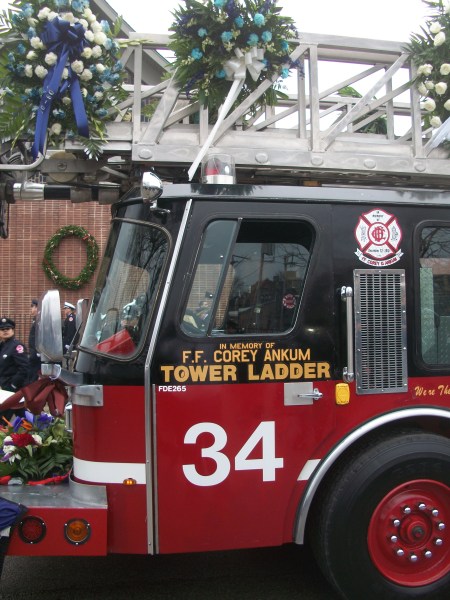
RIP Ed Stringer and Corey Ankum

Posted 01/02/2011 by IRONSandLADDERS
Categories: 7. Everything Else

Tags: ,

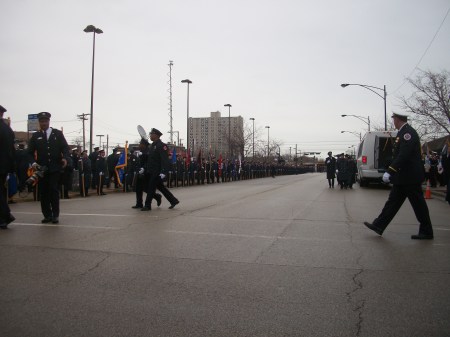
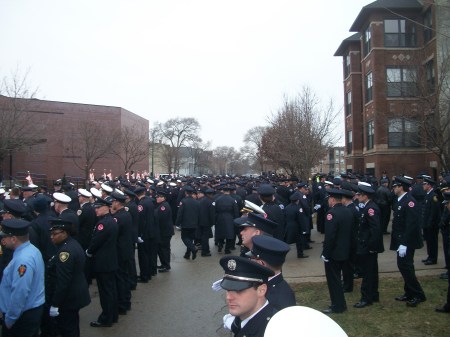
My Union and my Fire Department in the years past have started a tradition that I would encourage everyone to consider for their own area. When multiple firefighters die in the line of duty, our Union pays to fly and lodge two of our members to the represented city. Our fire department supports us by allowing guys the time off which is very helpful considering we fly out within days of the LODD happening. So a Thank You goes out to both of them.

I have attended my fair share of fire department funerals just in my own state, both multiple firefighter deaths from fire scenes and single non fire related deaths. Whatever the scenario, it does not matter. They all died from something related to our trade, and they all left families behind. When you have hundreds or even thousands of firefighters show up from around your state you can see the impact that it has on the families. You can see the realization that their husbands were part of something bigger than those families may have ever been aware of. The realization that firefighters would travel from around the country to honor someone they never knew simply because we shared the same beliefs of our chosen trade. Something discouraging however is the relatively small representation of firefighters that show up, compared to the thousands of them that are within a few hours driving distance to the services.

It was a good turnout in Chicago, I would guess each funeral had 1500 to 2000 show up just from the City, and another three or four hundred from out of town. I met some great guys from Chicago and around the country. In between the funerals we had a chance to talk a fair amount about the fire that killed these guys and some topics that arise with fires involving LODD’s.  I want to say thanks to Nate Demarse for taking time out of his day to drive us around the neighborhood and for taking us by the scene of the fire. It was a good reminder that things are not always as they appear. The fire building was much smaller than I had pictured by the photos. There was very little signs of smoke or fire damage in the back of the building where the collapse occurred. The front of the building looked no more run down or dilapidated than most of its surrounding buildings, or for that matter every other building on that street. 

Where am I going with this? Well I don’t get into a lot of my own opinion on this website and stick mainly to basics of our craft. However it’s getting hard to swallow the amount of people I hear, or see commenting online about this fire with no other intentions then saying they were wrong to go in that building. With no depth, or facts on their side they simply slander the names of these two by repeatedly saying to others “They shouldnt have been in there”. How can anyone throw that out there, especially if you were not at this fire?

On my way back to the Hotel in Downtown Chicago I had numerous homeless people yell “Thanks”, “Thanks For Caring” or “I’m Sorry” as I walked by. All they saw was what my Class A uniform represents, they had no clue I was from out of town. But what one of them specifically did know was the fact that the Chicago Firefighters would search for them, the homeless, the class of society that many may ignore. He had heard that the FD had gotten reports of squatters in the building, and was taken back by the fact that they would try to come in and get them. They were searching for them the same way they would search for an upper class family in a 5000 square foot mansion, or a blue collar family in a middle class bungalow.

Driving around the neighborhood of the fire made it very clear to me that there was a huge population of transient people in the area, and to go along with them there was hundreds, or more likely thousands of boarded up buildings. This was a “norm” in this area. Boarded up or vacant buildings is a normal part of the landscape in this part of Chicago. What will you find in them?  Homeless people lighting warming fires in the winter to survive. When this argument comes up I have heard people claim that these squatters are in there illegally in the first place, to me this is not a valid point. We don’t have the privilege of deciding who is in the right and who is in the wrong, that is why the FD has such a great love from the citizens. Because everyone is equal when the bells go off and we try to search for someone. It doesn’t matter if you are trespassing in a vacant building, or illegally have 12 people living in a 2 bed apartment, or your running drugs out of your house. Everyone is equally as important, which is why the original point is not valid. 

I am not writing a long winded article on what we should search, when and why. But I am saying I think it is horrible how fast “our own” will second guess, and monday morning quarterback our fallen without good intent. I say good intent because there is a difference in someone who wants to learn as much as they can from these fires and learn from others experiences as compared to someone who knows just enough about the fire to say I can’t believed they entered a vacant.

To wrap this up I think it is ironic how it seems most of the people that constantly have stuff to say about the faults of our fallen firefighters tactics and are quick to question the actions of every LODD fire are typically not found at these funerals in support of the department who has just lost them. So in honor of the ones of who have gone before us, I would hope you would try to make the next LODD death that is in your area, and to remember that we don’t know what happened at these fires strictly off news reports and online commentary.

Here is a brief news article on a fire in Chicago involving homeless that were rescued. This occurred very shortly after the fatal fire.      News Link
 

Multiple Firefighters Lost In Chicago

Posted 12/22/2010 by IRONSandLADDERS
Categories: 7. Everything Else

At least two firefighters have been killed in a multiple alarm fire this morning in Chicago. Early reports are saying multiple firefighters were trapped in a collapse with over a dozen being transported to hospitals. Keep our brothers in mind this morning.

This slideshow requires JavaScript.

Links to the news story

The Burning Van

Posted 12/07/2010 by IRONSandLADDERS
Categories: Uncategorized

I apologize for the lack of content over the last few weeks, we have some stuff in the works and will hopefully get back in the swing of things soon. We do have a video that was found over on http://statter911.com/ (credit is all his). Its one of those videos that will shock you, make you laugh and try to figure out what in the world is going on, and who the heck is the guy in the red shirt. Anyways take a look.